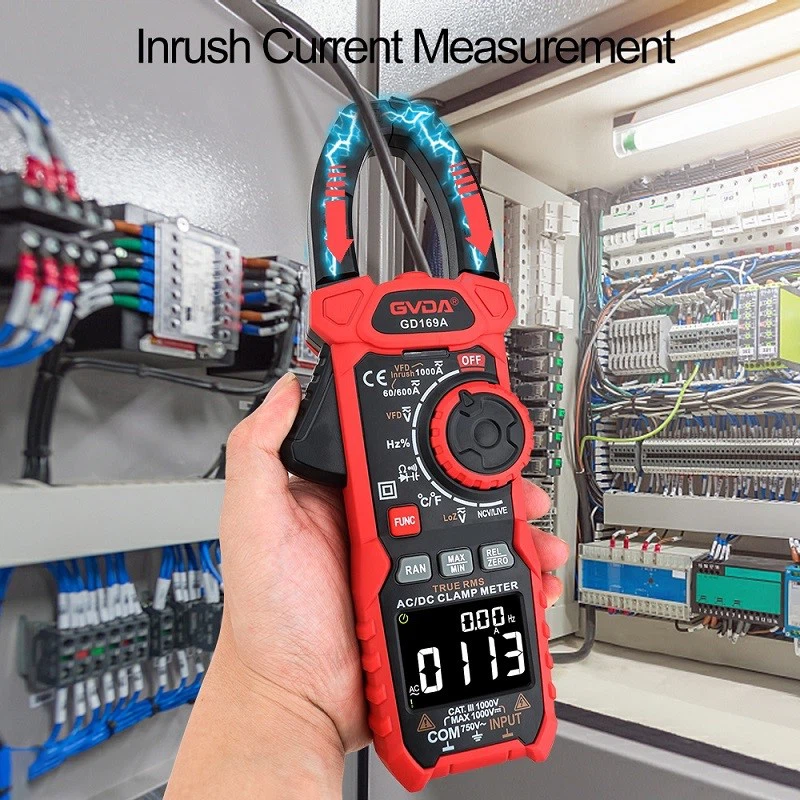
The structure and working principle of the clamp ammeter and its price introduction
When we electricians need to measure the current without disconnecting the circuit, we need to use clamp ammeter (sometimes referred to as clamp meter, clamp meter). A clamp ammeter is an instrument used to measure the current in a running electrical circuit, and it is a commonly used measuring tool for electricians. Clamp ammeters are divided into two categories: clamp AC ammeters and clamp AC/DC meters, some of which can also measure AC voltage.
The structure and working principle of the clamp ammeter:
The clamp AC ammeter is essentially composed of a current transformer and a rectifier instrument. The current-carrying wire to be measured is equivalent to the original winding of the current transformer, and the secondary winding of the current transformer is on the iron core. , the secondary winding is connected to the instrument of the rectification system. According to a certain proportional relationship between the primary and secondary windings of the current transformer, the rectifier instrument can display the current value of the measured line.
The clamp AC-DC meter is an electromagnetic system instrument. The measured current-carrying wire placed in the jaw acts as an excitation coil, and the magnetic flux forms a loop in the iron core. Deflect, get a reading. Because the deflection is not affected by the measurement current, it can measure AC and DC currents.
Clamp Meter Specifications
There are two types of clamp meters, analog and digital. Standard type detection range: AC and DC are around 20A to 200A or 400A, there are also products that can detect large currents of 2000A; there are also leakage detection products that can detect small currents of several mA, transformer power supplies, and switching power supplies The product of the true effective value (TRUERMS) of non-sine waves other than sine waves.
4. How to use
(1) Mechanical zero adjustment is required before measurement
(2) Select the appropriate range, choose the large range first, and then select the small range or see the nameplate value for estimation.
(3) When the minimum measuring range is used to measure and the reading is not obvious, the measured wire can be wound several times, and the number of turns should be based on the number of turns in the center of the jaw, then the reading = indicated value × range / full deviation × turns After the number (4) is measured, put the transfer switch at the maximum range.
(5) When measuring, the wire under test should be in the center of the jaws, and the jaws should be closed tightly to reduce errors.
5. Matters needing attention
(1) The voltage of the line under test should be lower than the rated voltage of the clamp meter.
(2) When measuring the current of high-voltage lines, wear insulating gloves, wear insulating shoes, and stand on insulating mats. (3) The jaws should be closed tightly and the range cannot be changed with electricity.