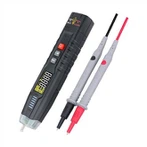
The temperature measurement principle and law of human infrared thermometer
The principle of infrared thermometer for temperature measurement is to convert the radiation energy of the infrared emitted by the object being measured into electrical signals. The magnitude of infrared radiation energy is related to the temperature of the object itself, and the temperature of the object can be determined based on the magnitude of the converted electrical signal. All objects above absolute zero will emit infrared radiation on their own. The function of an infrared thermometer is to collect the infrared radiation emitted by objects, and it does not emit any harmful radiation at all, so it is completely harmless to the human body. Some people misunderstand that infrared thermometers emit radiation onto the human body to produce readings, but this concept is incorrect.
The radiation law of human infrared thermometer
All objects in nature with temperatures above absolute zero (-273.15 ℃) continuously radiate electromagnetic waves, including infrared waves, into the surrounding space due to the thermal motion of molecules. The relationship between their radiation energy density and the temperature of the object itself conforms to the radiation law.
The temperature measuring instrument made using this principle is called an infrared temperature instrument. This type of measurement does not require contact with the object being measured, therefore it belongs to non-contact measurement. The infrared temperature instrument has a wide temperature measurement range, from -50 ℃ to above 3000 ℃. The wavelength distribution of electromagnetic wave energy emitted by objects varies in different temperature ranges. In the normal temperature range (0-100 ℃), the energy is mainly concentrated in the mid infrared and far-infrared wavelengths. The specific design of instruments used for different temperature ranges and for different measurement objects also varies.