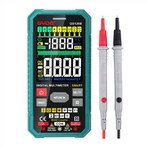
The use of digital multimeter ohm step
1, the red pen into the "V / Ω" jack, black pen into the "COM" jack, the function of the conversion switch rotated to the corresponding range of the ohm block, no input (such as open circuit) display shows "1 If there is no input (e.g. open circuit), the display will show "1". If the measured resistance exceeds the maximum value of the selected range, the display will show "1", then you should choose a higher range. For resistance greater than 1M, it takes a few seconds for the reading to stabilise, which is a normal phenomenon.
2, digital multimeter resistance gear, is strictly prohibited in the case of measuring resistance with electricity, and does not allow direct measurement of dry cell, button battery resistance, because this is equivalent to the multimeter with an input voltage, not only to make the results of the measurement is meaningless, but also very easy to damage the internal A/D analogue-to-digital converter of the multimeter.
3, the digital multimeter resistance block provides a small test current, in the detection of crystal diode forward resistance than the value measured by the pointer multimeter is several times higher, or even dozens of times, which is a normal phenomenon. This is normal. At this time, you can use the diode block to measure the forward voltage drop of the PN junction in order to obtain accurate results.
4, in the use of 200MΩ block to measure the high resistance value, the measured results should be subtracted from the value displayed when the meter pen is short-circuited.
5,When measuring low resistance with 200Ω resistor, the two pens should be short-circuited first, and the resistance of the two pens should be measured (generally 0.1~0.392), and then the measurement result should be subtracted from this value to be the actual value. For 2kΩ-20MΩ a few gear measurement, the red pen, black pen between the two lead resistance can be ignored.
In addition, the resistor itself are positive and negative error values, in the measurement of resistance components, not necessarily the same as the colour ring or the drawing on the calibration value. For example, 1000Ω resistance ± 2%, that is, in the 980Ω to 1020Ω are normal values.