The working principle and precautions of the glass electrode of pH meter
1. The glass electrode method is used to measure the pH value of the water sample. The saturated calomel electrode is used as the reference electrode, and the glass electrode is used as the indicator electrode to form a working battery with the measured water sample. Read the pH value. The glass electrode method is accurate and fast in measuring PH, and is less interfered by factors such as water chroma, turbidity, colloidal substances, oxidizing agents, reducing agents, and salinity.
2. Instruments and reagents
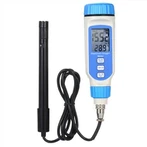
(1) Instrument a, pH meter or ion meter. b. Glass electrode, saturated calomel electrode
(2) Reagent a, preparation of standard buffer solution ① PH standard buffer solution A (PH4.008, 25°C): Weigh 10.12g of potassium hydrogen phthalate (KHC8H4O4) dried at 110-130°C for 2-3 hours, Dissolve in water and dilute to 1L in a volumetric flask. ②PH Standard Buffer Solution B (PH6.865, 25°C): Weigh 3.388g of potassium dihydrogen phosphate (KH2PO4) and 3.533g of disodium hydrogen phosphate (Na2HPO4) which were first dried at 110-130°C for 2-3 hours, and dissolve in water and dilute to 1L in a volumetric flask.
3. Operation steps
(1) Sampling According to sampling requirements, take representative water samples.
(2) Calibration of the instrument The operation procedure is carried out according to the instruction manual of the instrument.
(3) To measure the pH of the water sample, first rinse the electrode with distilled water, then immerse the electrode in the sample, carefully shake the test cup or stir to speed up the electrode balance, let it stand, and record the pH value when the reading is stable .
Precautions for use of pH meter glass electrode
(1) The accuracy of the measurement results firstly depends on the accuracy of the pH standard value of the standard buffer solution. Therefore, the buffer solution should be prepared and preserved according to GB11076-89 "Preparation Method of Buffer Solution for PH Measurement".
(2) Glass electrodes and Gangon electrodes should be selected, processed and installed according to the specifications.
(3) The pH value of the water sample should be measured on site, otherwise, the sample should be kept at 0-4°C after sampling, and the measurement should be carried out within 6 hours after sampling. Pure water is neutral, and its pH value is 7.0 at 25 degrees. Solutions below this value are acidic, and solutions above this value are alkaline. Pure water also ionizes (a decomposition process that breaks down charged ions), ionizing hydrogen ions
H+ and hydroxide ions OH- (+ and - signs are superscripts, indicating positive and negative charges), it has been proved that at 25 degrees, the hydrogen ions and hydroxide ions in the aqueous solution (whether it contains acid or alkali) The product of the concentrations is a constant, which is always equal to 10 to the power of -14. For example, when the concentration of hydrogen ions is 0.1 mol/liter, the concentration of hydroxide ions must be 10 to the power of 13 moles/liter. The ionization process of water can be expressed as follows: H2O == (H+) + (OH-), this is not an equation in mathematics, it only represents a process, that is, a water molecule can decompose into a hydrogen ion and a hydroxide ion . Since the degree of decomposition of water is affected by temperature, the pH value in pure water (without any impurities) is not always 7.0. Broadly speaking, acidity means that there are more hydrogen ions and perhydroxide ions in the solution. Generally speaking, the pH value will not be less than 0 or greater than 14. The concentration of hydrogen ions or hydroxide ions in such a solution is very large (more than 1 mol/liter), and the acidity or alkalinity of the solution will be It is directly expressed in concentration, not pH.