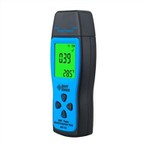
The working principle and technical specifications of a sound level meter
Product Definition
A sound level meter, also known as a noise meter, is a basic noise measurement instrument. It is an electronic instrument, but it is different from objective electronic instruments such as voltage meters. When converting sound signals into electrical signals, the time characteristics of the human ear's response speed to sound waves can be simulated; The frequency characteristics with different sensitivities to high and low frequencies, as well as the intensity characteristics that change the frequency characteristics at different loudness levels. Therefore, a sound level meter is a subjective electronic instrument.
Signal to Noise Ratio (SNR): Signal to Noise Ratio (SNR), also known as Signal to Noise Ratio (SNR), refers to the ratio of useful signal power to useless noise power (the ratio between the maximum undistorted sound signal intensity produced by a sound source and the noise intensity emitted simultaneously, usually expressed as "SNR" or "S/N", usually in decibels (dB). The higher the signal-to-noise ratio, the better.)
For example, we know that when a radio listens to radio or a recorder plays music, in addition to the sound of broadcasting and music, the speaker always contains various noises. Some of these noises are interference generated by lightning, motors, electrical equipment, etc; Some are generated by the components and devices of the electronic device itself. All these noises are called noise. The lower the noise, the clearer the sound of broadcasting and music. In order to measure the quality of electroacoustic equipment, the technical indicator of "signal-to-noise ratio" is commonly used. The so-called signal-to-noise ratio refers to the ratio of useful signal power S to noise power N, denoted as S/N.
Product Usage
Noise meters are mainly used to measure noise, and the classification of noise measurement mainly includes the following types:
1. From the measurement object, it can be divided into feature measurement of environmental noise (sound field) and measurement of sound source features.
2. From the time characteristics of the sound source or sound field, it can be divided into steady-state noise measurement and non-stationary noise measurement (noise with a sound level fluctuation of no more than 3dB (A) during the measurement time is considered steady-state noise, otherwise it is called non-stationary noise). Non steady state noise can be further divided into periodic noise (noise with significant periodic changes in sound level during measurement time), irregular noise, and pulse noise (pulse noise is non continuous and consists of irregular pulses or noise spikes with short duration and large amplitude, as explained in the tool book: noise with a duration of less than 0.5 seconds and an interval of more than 1 second).
3. From the frequency characteristics of the sound source or sound field, it can be divided into broadband noise (noise with flat spectral density maps), narrowband noise, and noise containing prominent pure tone components.
4. From the perspective of measurement accuracy requirements, it can be divided into precision measurement, engineering measurement, and noise survey, etc
An integral sound level meter is used to measure the equivalent sound level of unstable noise over a period of time. (TES1353)
A noise dosimeter is also an integral sound level meter, mainly used to measure noise exposure. (TES1355, AWA5610 series)
Pulse sound level meters are used to measure pulse noise, which correspond to the response of the human ear to pulse sound and the average time of the human ear's response to pulse sound. (CEL-254)