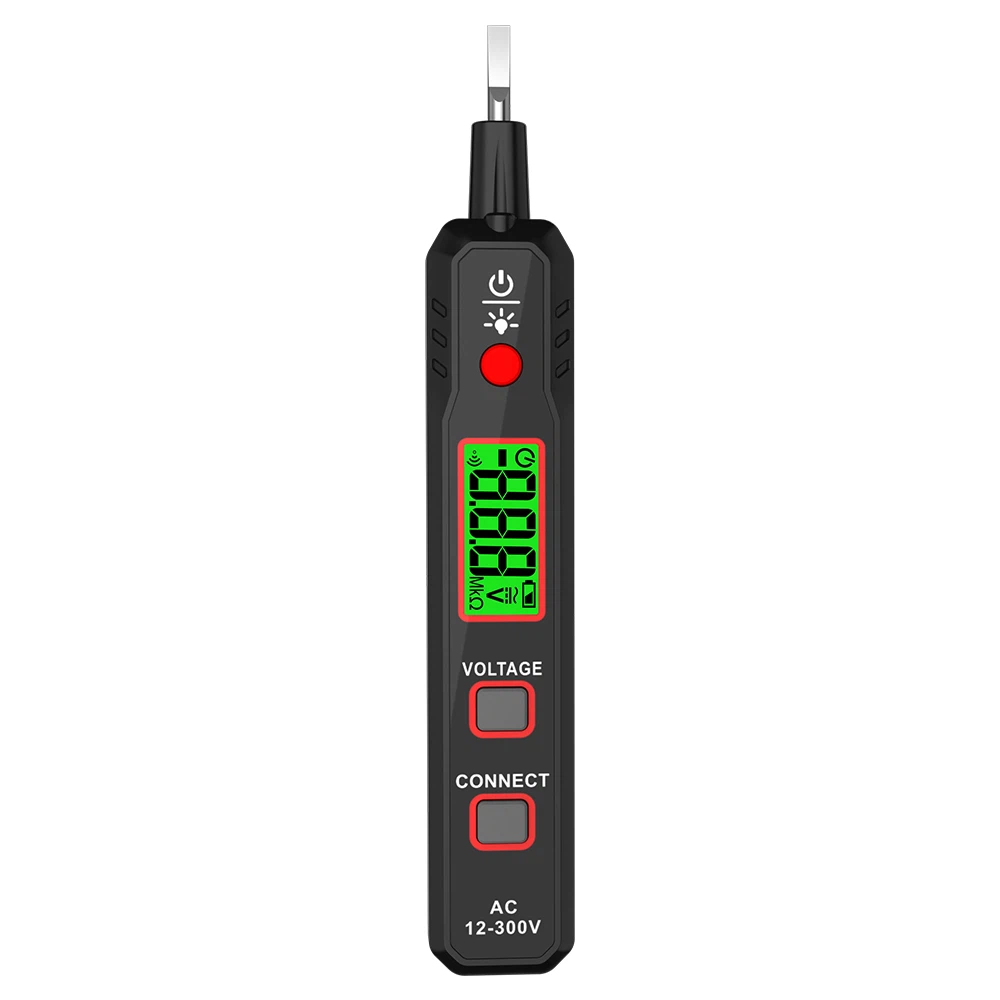
There are so many uses for the electric measuring pen
The electric pencil (also known as the electric pencil) is one of the commonly used tools for electricians, which is used to judge whether the object is charged or not. Its measuring range is between 60 and 500V, and it has a pen type and a screwdriver type. It is composed of neon tubes (commonly known as neon bulbs), resistors, springs, etc. When in use, the charged body forms a potential difference through the electric pen, the human body and the earth to generate an electric field, and the neon tube in the electric pen will emit light under the action of the electric field. When using the electric pen, you must hold it correctly. The thumb and middle finger hold the insulation of the electric pen, and the index finger presses the metal cap on the end of the pen.
The tester must be confirmed to be in good condition before use (test at a place with a real power supply) before use. When in use, it should be gradually approached to the measured object until the neon tube glows before it can be in direct contact with the measured object.
Do you know these uses of the electric measuring pen?
(1) It can be used for low-voltage phase verification to measure whether any wires in the line are in phase or out of phase. The specific method is: stand on an object insulated from the earth, hold a test lead in each hand, and then test on the two wires to be tested. If the two test leads glow brightly, the two lead wires are different. On the contrary, it is the same phase, which is judged by the principle that the voltage difference between the two poles of the neon bulb in the test pen is proportional to its luminous intensity.
(2) It can be used to distinguish between alternating current and direct current. When testing with a test pen, if both poles in the neon bulb of the test pen glow, it is alternating current; if only one of the two poles glows, it is direct current.
(3) It can judge the positive and negative poles of direct current. Connect the test pen to the DC circuit for testing, the pole that glows on the neon bulb is the negative pole, and the pole that does not shine is the positive pole.
(4) It can be used to judge whether the DC is grounded or not. In a DC system that is insulated from the ground, you can stand on the ground and touch the positive or negative pole of the DC system with a test pen. If the neon bulb of the test pen does not light up, there is no grounding phenomenon. If the neon bulb lights up, it means that there is a grounding phenomenon, and if it lights up like it is on the tip of the pen, it means that the positive electrode is grounded. If the light is on the finger end, it is the negative ground. However, it must be pointed out that in a DC system with a ground monitoring relay, this method cannot be used to determine whether the DC system is grounded.
Classification of test pens
Classification according to the level of the measured voltage
High-voltage measuring pen: used for 10kv and above projects, and is a daily testing tool for electricians;
Low-voltage measuring pen: used for the detection of charged objects with a line voltage of 500V and below.
Weak current testing pen: used for testing electronic products, the general test voltage is 6v--24v. For ease of use, the tail of the electric pen often has a lead wire with a clip.
Classification according to contact mode
Contact test pen: A detection tool that obtains electrical signals by contacting a charged body. It is usually shaped like a flat-blade screwdriver, which can also be used as a test pen and a flat-blade screwdriver; it is in the form of a pen, and displays the measurement data directly on the LCD window.
Inductive test pen: It adopts inductive test without physical contact, and can check the voltage on the control line, conductor and socket or check the open circuit position along the wire. The personal safety of testing personnel can be guaranteed to the greatest extent.