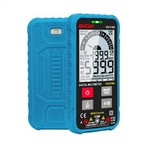
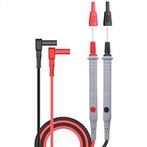
There is a dedicated capacitance meter to measure the capacitance of the capacitor.
Detection of fixed small capacitors
1. Detecting small capacitors below 10pF: Due to the small capacity of fixed capacitors below 10pF, using a multimeter for measurement can only qualitatively check for leakage, internal short circuits, or breakdown phenomena. When measuring, a multimeter resistor can be selected, and two probes can be connected to either pin of the capacitor. The resistance value should be infinite. If the resistance value (pointer swinging to the right) is zero, it indicates that the capacitor is damaged by leakage or internal breakdown.
2. Check whether there is charging phenomenon in the fixed capacitor with 10PF~0.01 μ F, and then determine its quality. The multimeter should be set to resistance mode. The beta values of both transistors are above 100, and the penetration current is higher. Therefore, 3DG6 and other types of silicon transistors can be used to form a composite transistor. The red and black probes of the multimeter are respectively connected to the emitter e and collector c of the composite tube. Due to the amplification effect of the composite transistor, the charging and discharging process of the measured capacitor is amplified, which increases the amplitude of the multimeter pointer and facilitates observation. It should be noted that during testing operations, especially when measuring capacitors with smaller capacities, the pins of the tested capacitor should be repeatedly switched to contact points A and B in order to clearly see the swing of the multimeter pointer.
3. For fixed capacitors above 0.01 μ F, the R × 10k range of a multimeter can be used to directly test whether the capacitor has a charging process and whether there is an internal short circuit or leakage. The capacitance of the capacitor can be estimated based on the amplitude of the pointer swinging to the right.