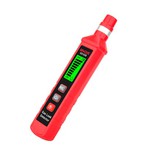
Three considerations for accurate ultrasonic thickness gauge measurements
Ultrasonic thickness gauge is mainly host and probe two parts, the host circuit includes transmitting circuit, receiving circuit, counting display circuit three parts, the high pressure shock wave generated by the transmitting circuit to stimulate the probe, generating ultrasonic emission pulse wave, the pulse wave by the interface of the medium after the reflection is received by the receiving circuit, through the single-chip microcomputer counting processing, through the LCD display the thickness of the numerical value, which is mainly based on the acoustic wave in the specimen It is mainly based on the acoustic wave in the specimen propagation speed multiplied by half of the time through the specimen and get the thickness of the specimen.
Ultrasonic thickness gauge is based on the principle of ultrasonic pulse reflection to carry out thickness measurement, when the ultrasonic pulse emitted by the probe through the object under test to reach the material interfaces, the pulse is reflected back to the probe, through the measurement of ultrasonic propagation time in the material to determine the thickness of the material under test. Where the ultrasonic waves can be made to propagate at a constant speed within the various materials can be measured using this principle.
As ultrasonic processing is convenient, and has good directivity, ultrasonic technology to measure the thickness of metal, non-metallic materials, both fast and accurate, no pollution, especially in only one side of the permit can be pressed and touched the occasion, can show its superiority, widely used in a variety of plates, tubes, boiler vessel wall thickness and its local corrosion, corrosion, and so on metallurgy, shipbuilding, machinery, chemical industry, electric power, atomic energy and so on the various Product inspection of industrial sectors, equipment operation and modern management plays a major role.
Ultrasonic waves in the encounter air will sharply attenuate the air, in order to allow the discharge of ultrasonic probe and the air between the workpiece, the use of ultrasonic coupling agent to remove. Usually in the factory to measure the smooth surface of the workpiece using general oil or other non-corrosive liquids can be used, the rougher surface can be used more viscous butter, the measurement is complete, be sure to probe the surface as well as the surface of the standard block of coupling agent to erase the surface. Repeated measurements at the same point, each time the probe away from more than 10cm, after a few seconds interval, to avoid the measured material due to the magnetisation of the probe, affecting the results of the next measurement.
The use of ultrasonic thickness gauge, plane zero measurement plane, convex zero measurement convex, concave zero measurement concave surface, to avoid measurement errors due to different structures; try to use the measured material as the zero base, to avoid different materials due to different magnetic conductivity, and measurement errors; try to zero in the same part of the measured material, and then measure the same part. For example, in the edge of the workpiece and the middle part should be zeroed separately; do zero with the surface, to be as smooth as possible; the roughness of the surface of the material under test has a great impact on the measured value, if the surface is not smooth, depending on the situation to take the average value; measurement, the probe should be kept perpendicular to the surface of the material under test, otherwise it will produce a large error.
Ultrasonic probe in contact with the surface of the object under test, the main controller controls the transmitter circuit, so that the ultrasonic waves emitted by the probe to reach the bottom surface of the object under test reflected back, the pulse signal is received by the probe, amplified by the amplifier added to the oscilloscope vertical deflection plate. The marker generator outputs the time marker pulse signal, which is added to the vertical deflection plate at the same time. The scanning voltage is added to the horizontal deflector. Therefore, on the oscilloscope can be read directly between the transmission and reception of ultrasound time interval t. The thickness of the object to be measured h is: h = ct / 2, where c is the speed of propagation of ultrasound.