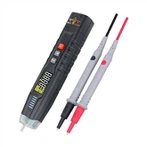
Tips for measuring DC with a multimeter
1, Perform mechanical zeroing.
2, Choose the appropriate range gear.
3, When measuring current with a multimeter current mode, the multimeter should be connected in series in the sub test circuit, because only a series connection can make the current flowing through the multimeter the same as the current of the measured branch. When measuring, the tested branch should be disconnected and the red and black probes of the multimeter should be connected in series between the two disconnected points. Special attention should be paid to not connecting the ammeter in parallel with the sub test circuit, as this is very dangerous and can easily cause the multimeter to burn out.
4, Pay attention to the polarity of the measured electricity.
5, Correctly use scales and readings.
6, When selecting the 2.5A mode with DC current, the red probe of the multimeter should be inserted into the 2.5A measuring socket, and the range switch can be placed on any range of the DC current mode.
7, If the measured DC current is greater than 2.5A, the 2.5A range can be extended to 5A range. The method is very simple. The user can connect a 0.24 ohm resistor between the "2.5A" socket and the black probe socket, so that the gear becomes the 5A current gear. The 0.24A resistor used for connection should be a wire wound resistor of at least 2W. If the power is too low, it may burn out.
Easily distinguish between neutral and live wires with a multimeter
You can easily measure the neutral and live wires in your home with a multimeter, as long as you use a digital multimeter, clamp type multimeter, or pointer mechanical multimeter for the AC voltage range. Turn the range switch of the multimeter to the AC voltage range (all multimeters should have this function, with a range from 200mV to 750V, usually choosing 200V range. Some clamp type meters do not have 200V range, so you can choose a larger range. If the pointer multimeter range is smaller, you can choose 10V100V). Then insert the red and black probes into the V/COM (the socket for measuring 220V voltage of household appliances) and wrap the black probe wire 2-3 times in the left hand (as shown in the picture). Of course, the more, the better. Note: at this time, do not touch the metal needle of the black probe with your hand to prevent electric shock. Then you can test it. Take the red probe and measure the socket or neutral wire separately. Record the results of the two measurements, and there must be a large and a small voltage between them. The larger voltage measured is the live wire, and the smaller voltage value is of course the neutral wire. If the ground wire is measured, there must be no smaller voltage or even no voltage (depending on whether your home's ground wire is connected). The difference between the measured voltage of the neutral wire and the live wire is clear at a glance.