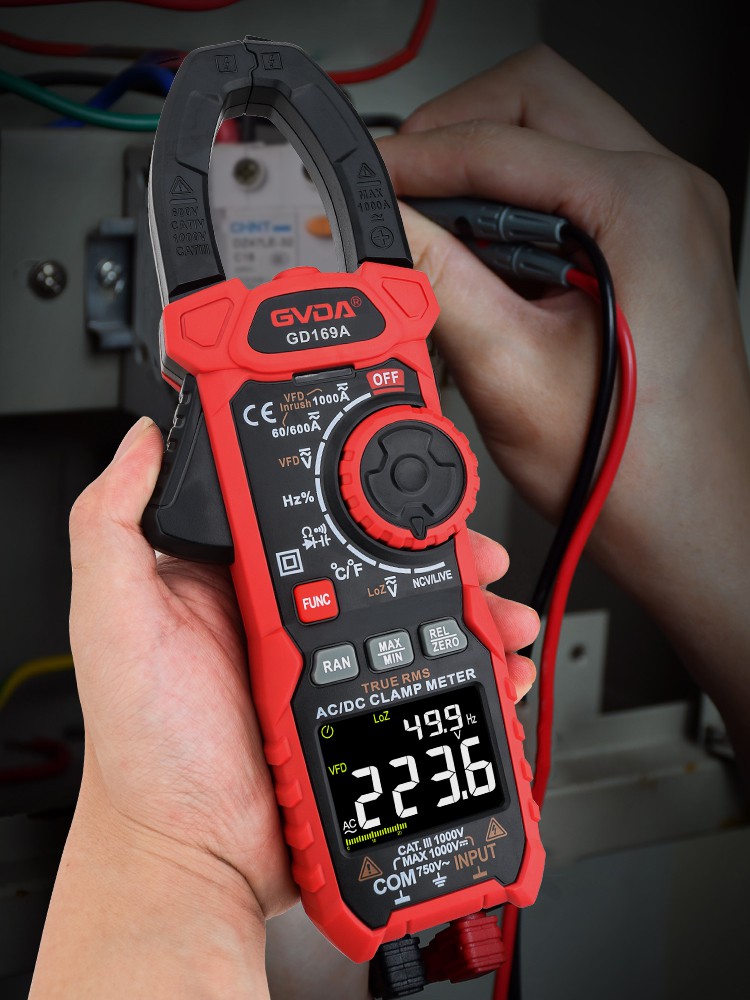
To use a clamp meter in residential applications:
Using Clamp Meters in Residential Applications
For residential electricians, a clamp meter is an essential tool for measuring loads on individual branch circuits at the switchboard. While a spot check of the current is often sufficient, sometimes this check does not provide a complete picture as the load is turned on and off, over several cycles, etc. Voltage in an electrical system should be stable, but current varies widely.
To check for peak or worst-case loads on a circuit, use a clamp meter with a min/max function designed for measuring high currents that exist for longer than 100 ms or about 8 cycles . These currents can cause intermittent overload conditions that can cause annoying tripping of the circuit breaker.
Take measurements on the load side of a circuit breaker or fuse. A circuit breaker will open the circuit in the event of an accidental short. This is especially important for any type of direct contact voltage measurement. Even though the clamps of a clamp meter are insulated, and thus have a level of protection not found in direct contact voltage measurements, caution is still necessary.
A common problem in electrical work in residential facilities is mapping electrical outlets to circuit breakers. Clamp meters are useful in identifying which circuit a particular outlet is on. The first thing to do is to obtain a baseline reading of the current current of the circuit at the switchboard. Then, put the clamp meter in min/max mode. Go to the relevant outlet, plug in a load (a hair dryer is ideal), and turn it on for a minute or two. Check that the maximum current reading of the clamp meter has not changed. A hair dryer typically draws 10-13 A, so there should be a noticeable difference. If the readings are the same, the correct circuit breaker is used.