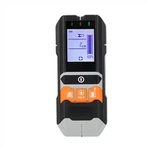
Two instructions for using a multimeter
Use a multimeter to determine the positive and negative poles of a speaker
Firstly, set the pointer multimeter to the DC 0-5mA range, and then connect the two probes to the two solder pads of the tested speaker. Gently press the paper tray of the speaker with your hand and observe the direction of the multimeter pointer's swing. If the pointer deflects in the positive direction, the red probe is connected to the negative terminal of the speaker, and the black probe is connected to the positive terminal of the speaker. On the contrary, the red probe is connected to the positive pole, and the black probe is connected to the negative pole.
Using a multimeter to judge the quality of piezoelectric ceramics
Piezoelectric ceramics are a type of artificially synthesized piezoelectric material. When subjected to external pressure, charges are generated on both sides, and the amount of charge is proportional to the pressure. This phenomenon is called the piezoelectric effect. Piezoelectric ceramics have piezoelectric effect, which means that they will deform under the action of an external electric field, so piezoelectric ceramic pieces can be used as sound emitting elements By utilizing the piezoelectric effect of piezoelectric ceramics, a multimeter can be used to determine their quality Lead two wires out of the two poles of the piezoelectric ceramic piece, then place the ceramic piece flat on the table, connect the two leads to the two probes of the multimeter respectively, set the multimeter to the minimum current mode, and then gently press the ceramic piece with a pencil eraser. If the multimeter pointer swings significantly, it indicates that the ceramic piece is intact; otherwise, it indicates that it is damaged
Performance parameters of pointer multimeter
1. The maximum scale and error are usually expressed as the maximum scale value and allowable error of a multimeter to indicate its performance. The maximum scale value and error of the multimeter are shown in the following figure.
2. Accuracy and fundamental error. Accuracy is generally referred to as precision, which represents the degree of accuracy of measurement results. The basic error is expressed as a percentage of the range on the scale, and if the scale has uneven characteristics, it should be expressed as a percentage of the scale length. The accuracy level and basic error comparison table are as follows.
3. When the multimeter is in operation, the difference between the two readings corresponding to the same dividing line, which increase (increase) and decrease (decrease) from zero to the upper range and then decrease (decrease) smoothly to zero, and the actual value measured, is called "market value fluctuation", abbreviated as fluctuation