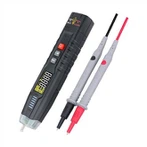
Two methods of measuring resistance with a multimeter
There are two main types of multimeters, which can be divided into digital multimeters and pointer multimeters. Compared to pointer multimeters, multimeters have higher accuracy, faster measurement speed, larger input impedance, stronger overload capacity, and more functions. They really live up to their name, so they are widely used in electrical and electronic technology measurement. Let's take a look at some of their resistance measurement methods
(1) Measure the resistance of a resistor:
The multimeter is used to measure resistance in the resistance range. A certain model of multimeter on the market has 200 Ω range, 2000 Ω range, 20K Ω range, 200K Ω range, and 2000K Ω range. The specific measurement method is as follows:
1. Select the gear.
It is estimated that the resistance value of the tested resistor will not exceed 20K Ω. According to the principle that the gear should be higher than and the resistance value of the tested resistor should be the quietest, the 20K Ω gear is more suitable. If it is not possible to estimate the resistance value, it is recommended to use a higher measurement gear. If it is found to be too small, then change to a suitable resistance gear based on the displayed resistance value and re measure.
(2) Measured wire resistance:
The resistance of a wire is related to the conductor material, cross-sectional area, and length. For wires made of the same conductor material, the lower the resistance of the core wire at the beginning of the month, and the longer the core wire, the higher the resistance. The resistance of the wire is relatively small, and a multimeter is generally used to measure in the 200 Ω range. The measurement operation is shown in the following figure. If the resistance of the tested wire is infinite, the wire is open.
Attention: When using a multimeter with a 200 Ω range for measurement, short circuiting the two probes will usually result in the displayed resistance value being non-zero, usually between a few ohms and a few ohms. This resistance value is mainly the probe and error resistance value. A high-performance digital multimeter has a very small value. Due to the high requirement for measurement accuracy, if a digital multimeter is used for Ohm zeroing, the resistance value when the probe is short circuited can be recorded before measurement, and the actual resistance value of the tested component or circuit can be obtained by subtracting this resistance value from the measured value.