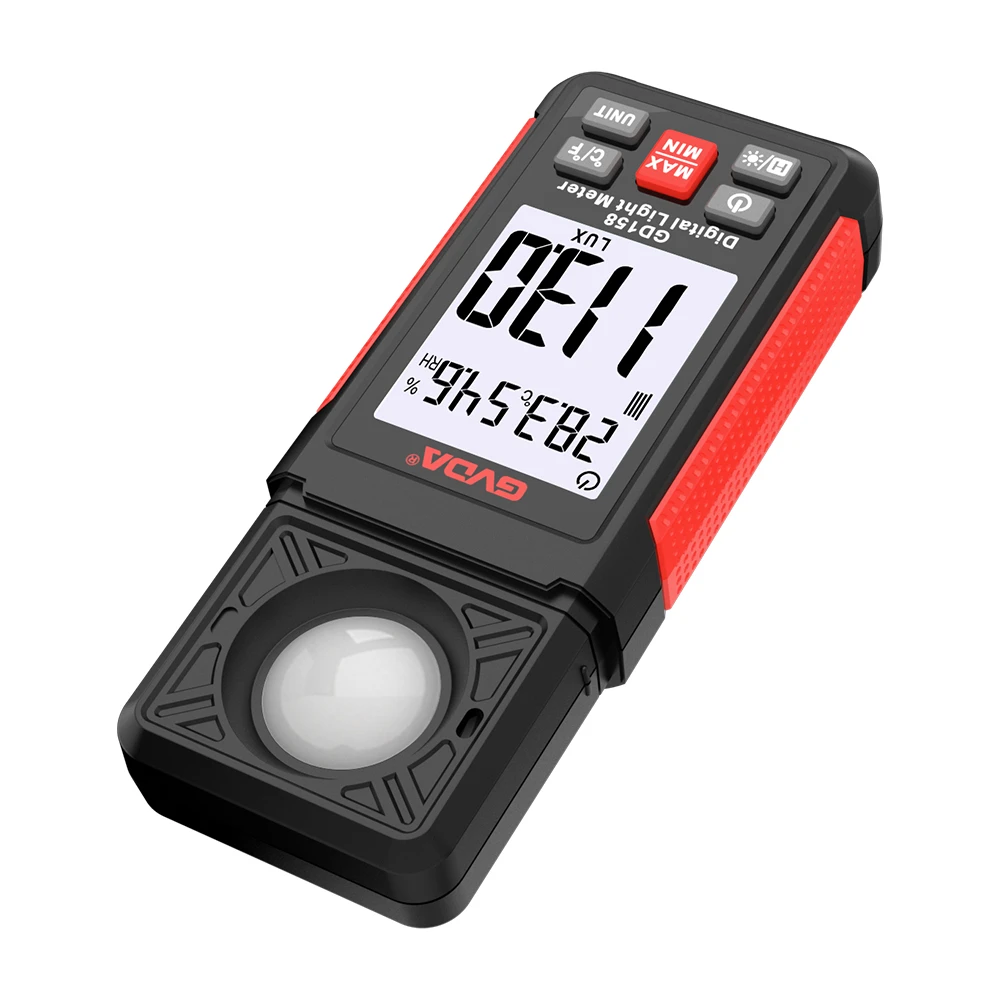
Uncertainty Assessment of Measuring Results of Light Meter Indication Error
Photometers are frequently used in municipal medical care, business and agriculture, and building development to measure lighting. The light track calibration method is utilized, and the illuminance produced by the light intensity standard lamp at a specific distance is used to calibrate the meter under test, in accordance with the requirements of JJG245-2005 "Illuminance Meter Verification Regulations". A luminance standard lamp, a light track with a scale (containing a detector trolley, a diaphragm, a lamp holder, and a filament plane adjustment device), and a DC regulated power supply (digital display) make up the illumination standard device. A completely dark room is required for the calibration process.
1 Evaluation of the primary variables influencing the measurement outcomes
Assemble the 2856K first-class standard lamp of luminous intensity and the illuminance meter under inspection at the authorized location of the photometric measuring device in accordance with the pertinent procedures outlined in the verification requirements. Warm up the standard lamp by turning it on. Change the distance between the standard lamp and the photometric head once the standard lamp's current is stable, then read the illuminance meter's display value, compute the display value's error, and assess its uncertainty. There are a lot of tight criteria for employees and equipment while calibrating light meters.The operator's technical proficiency and equipment choice will have an impact on the equipment's compatibility with the light meter filter, the shielding effect of stray light, the electrical measurement system, distance measurement, and the stability of the light source in the standard system.
1.1 Determining the length and light track
The light track calibration method largely completes the value transfer of laboratory illumination.
Since this method fully exploits the inverse square law of distance, E=1/2, errors will be introduced by the linearity of distance measurement and light track.
The linearity error of the light track itself must not be greater than 1mm, and the total error within 1m of the ranging meter must not be greater than 0.2mm.
Filament plane and receiving surface of the optical head
Personnel with training and experience in optical path adjusting, alignment, and other tasks are needed for calibration. Use the alignment tool to make sure that the aperture of the diaphragm, the receiving surface of the illuminance meter, and the plane of the standard lamp filament are all perpendicular to the optical axis. Each center should also be situated on the optical axis. On the other hand, finish the optical path to lessen the error brought on by incorrectly adjusting the filament plane and the optical head's reception surface.
1.3 Usual illumination
Since the luminous intensity of the reference lamp is utilized for calibration, the accuracy of its luminous intensity must be closely regulated. Standard lights of level 1 with a change amplitude of the luminous intensity that must not be greater than 0.6% and whose horizontal and vertical angles must meet the required angles. Standard lamps rotate by 1.5° in the horizontal direction or 1.0° in the vertical direction. A maximum annual change rate of 0.7% is allowed.
1.4 Electrical measurement system
To troubleshoot the DC stabilized power supply, refer to the technical specifications: The standard lamp should be heated, warmed up, and stabilized before measurement to assure the standard lamp's luminosity; the output voltage is constantly adjustable, and the amplitude of the output voltage change during ten minutes shall not exceed 0.02%. The power is faithfully replicated.
Even if the standard lamp's working current value is compatible with the current value used for verification, the exact same electrical measurement equipment is typically not utilized, therefore the standard lamp's actual working current value is typically different. This introduces mistakes.
1.5 Light meter filter spectral properties
When measuring illuminance, the silicon photodiode or silicon photocell used in the illuminance meter is inconsistent with v () and a correction filter must be added. The spectral responsivity distribution s() of the detector should be consistent with the photopic efficiency v() of the International Commission on Illumination (CIE). However, the matched s() and v() cannot be perfectly consistent, and inaccurate results will arise from insufficient matching.
1.6 Shielding from stray light
To avoid stray light from blending into the optical channel and ruining the experimental results, the supporting equipment's materials, such as moving apertures, curtain apertures, etc., must be capable of effectively shielding light. In practical testing, the stray light generated by the verification equipment itself cannot be totally protected, interfering with the readings of the illuminance. However, the shielding of stray light from the outside is reasonably in place.