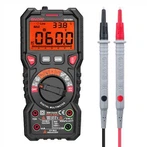
Use a multimeter to test 6 commonly used electronic components?
Whenever the circuit board cannot operate according to normal conditions, and there is no problem after checking the circuit, it is very likely that an electronic component is broken. If you want to repair it, you must find the problem component and replace it, but the problem component is found. It is a technical job and requires certain skills. Today I will teach you how to use a multimeter to test some commonly used electronic components.
Resistance detection
The most direct way to detect resistance is to use the resistance setting of a multimeter to measure it. Generally, the resistance will be marked on the resistance. Choose the appropriate resistance setting and connect the red and black test leads to both ends. If the reading is close, it is normal. Otherwise, it is broken. During the measurement, When measuring resistance, be careful not to touch the red and black test leads with both hands. This is not to cause any danger, but to ensure the accuracy of the resistance measurement. It is okay to touch one of the test leads with your hands.
Potentiometer detection
Normally, a potentiometer has three pins. First, use a multimeter to select the resistance setting and test whether the resistance between two of the three pins of the potentiometer is or is close to the resistance marked on the potentiometer. If there is a big difference, it means the potential The device is damaged. If the multimeter continues to measure these two pins normally, then rotate the potentiometer counterclockwise to the position close to off. At this time, the resistance value is as small as possible. Then rotate it clockwise. If the resistance gradually increases, Rotate until the final resistance value is close to the marked resistance value, then the potentiometer is normal.
Fixed capacitor detection
In addition to using a multimeter to select the appropriate range of the capacitor range to measure the capacitance value, you can also use the resistance range to measure. When measuring, you must choose the appropriate resistance range. Use two test leads to connect the two pins of the capacitor respectively. The resistance value should be infinite. If If the resistance value is 0, the capacitor is damaged.
Electrolytic capacitor detection
The measurement methods of electrolytic capacitors and fixed capacitors are a little different. Of course, you can choose to use a capacitor barrier to test. Everyone knows this. Let me talk about the method of measuring with an electrical barrier. First, select the appropriate resistance range. The red test lead and the black test lead touch the capacitor respectively. Two poles, then the displayed value will increase from 0 until the overflow symbol 1 is displayed. If it always displays 0, it means there is a short circuit inside the capacitor. If it always displays 1, it means there is an open circuit between the capacitor poles. It is also possible that the resistance level is not appropriate. Here it must be It should be noted that when measuring, since the electrolytic capacitor has positive and negative poles, be sure not to reverse the connections here. Normally, the red test lead is connected to the anode of the capacitor (the one with the longer leg), and the black test lead is connected to the cathode of the capacitor (the one with the short leg). , the pointer multimeter is just the opposite.
Inductance detection
Also select the resistance setting of the multimeter and connect the test leads to both ends of the inductor. If the measured resistance value is zero, the inductor is internally short-circuited. Under normal circumstances, the DC resistance of the inductor being measured is related to the diameter of the enameled wire used to wind the inductor coil, and the wire winding There is a direct relationship with the number. As long as the resistance value can be measured, the inductance can be considered normal.
Diode detection
Adjust the multimeter to the diode detection position, connect the red test lead to the anode of the diode, and the black test lead to the cathode of the diode. If the voltage drop of the diode is displayed on the display (usually 0.5 for silicon tubes and 0.2 for germanium tubes), it means that the diode is normal. Replace the test leads. , if the display shows 1, it is normal, otherwise it is broken down. If the two test results are both 0 or 1, it means the diode is damaged.
LED detection
Also adjust the digital multimeter to the diode detection position, touch the red test lead to the anode of the LED, and the black test lead to the cathode of the LED (same as the diode above). If you see it glowing, it means it is normal, otherwise it is damaged.