Use a resistance gear to detect circuit paths and short circuits without dots!
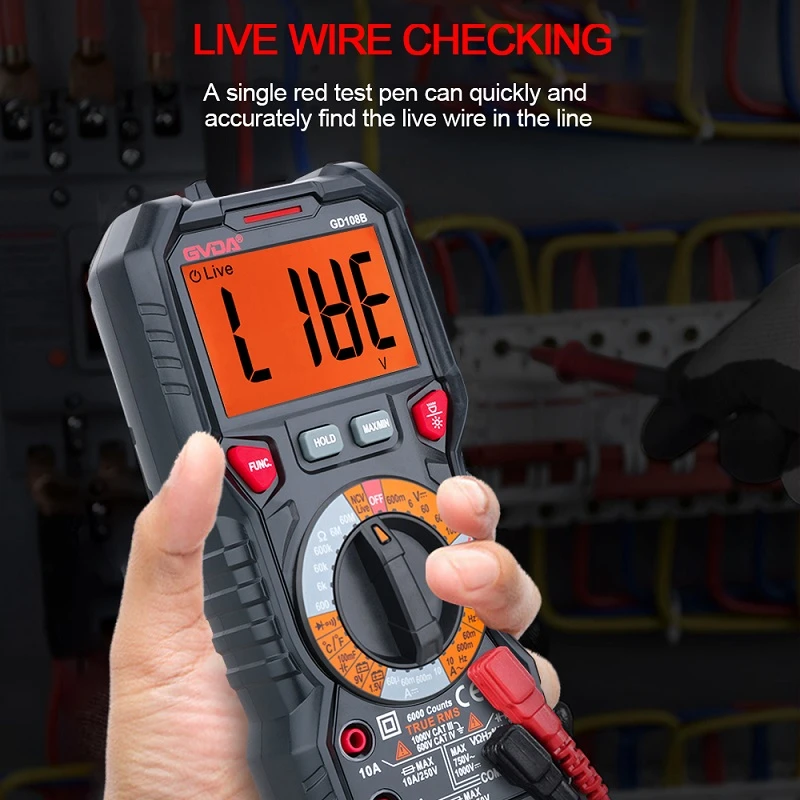
A multimeter has a beep stop, which means using two probes to measure the same wire. If there is a short circuit, there will be no response. If it is a circuit, there will be a beep sound. Sometimes, when the device itself is grounded poorly and the casing is live, a multimeter can be used. The red probe is placed on the casing, and the black mark is directly in contact with the ground. The strength of the casing leakage current can be measured, so that it can be connected in series to the circuit for AC and DC current measurement in the remaining work.
To check for leakage in the circuit, a megohmmeter (shake meter) should be used, as the voltage of the multimeter is lower (9V) and the voltage of the megohmmeter is higher (500V). Because the working voltage of the circuit is 220V, it is difficult to diagnose circuits with unclear leakage. To use a digital meter to check for circuit leakage, the power supply needs to be cut off first. After discharging the circuit, measure it with a resistance level of 2M, and the normal display is 1 (infinite).
To measure whether the circuit is in a connected state, a multimeter can be used to measure the ohmic range. When measuring, it is necessary to select the meter pointer to be close to the 0 ohm deviation range. If the circuit is in a circuit, one end (A end) of the circuit should be connected to a multimeter (red probe) with a 100 ohm range, and the black probe should be connected to the other end (B end) of the circuit to be measured. If the measured result is zero, it indicates that the circuit is connected, also known as a path. Only a path can current flow through the circuit; If the multimeter ohmmeter pointer at the A to B end of the circuit is not close to zero ohms, then the circuit is already in an open circuit state. Breaking it is called an open circuit or an open circuit.
A multimeter can easily identify the cause of leakage.
Fault finding and analysis
Firstly, inquire about the fault symptoms and obvious features of the repair user; Next, observe the surface for any obvious fault points before proceeding to the next step of inspection.
1. First, disconnect the main isolation switch of the user's power inlet, turn off all electrical loads of the user, such as unplugging the refrigerator plug, disconnecting the water pump switch, etc.
2. Place the gear of the digital multimeter on the 200M gear of the ohm gear, with one probe placed on one of the two output wires on the load side, and the other probe touching a wall, preferably the grounding wire or temporary grounding wire. After the number displayed on the multimeter stabilizes, the reading is the insulation resistance value of the main circuit. If the insulation resistance value is less than 0.5 megaohms, it is a problem with the main circuit. If the insulation resistance is above 0.5 megaohms, it can be ruled out that there is a problem with the main circuit. Measure the other wire using the same method and also check the value to see if there is a problem with the main circuit.
3. Check the insulation resistance values of the branch and various electrical appliances, and use the same method to test them one by one until the fault point is found.