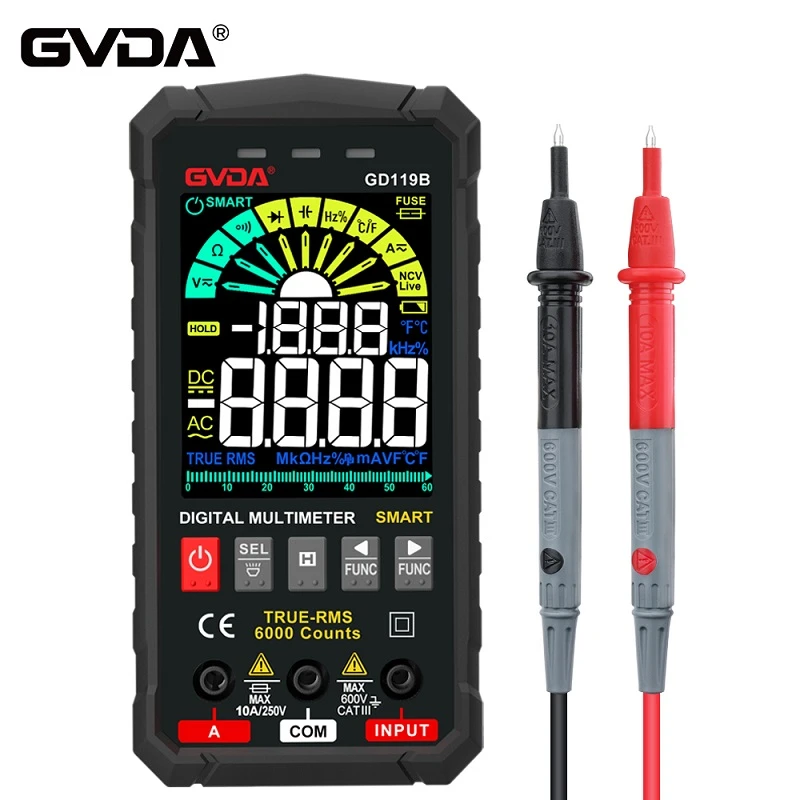
Using a multimeter as a sensor
1. Measuring wire and cable breakpoints
When there is a disconnection fault inside the cable or the cable, the exact location of the disconnection is not easy to determine due to the wrapping of the outer insulation. This problem can be easily solved with a digital multimeter. Specific method: Connect one end of the wire (cable) with a breakpoint to the live wire of the 220V mains, and the other end to hang in the air. Pull the digital multimeter to the AC2V gear, start from the live wire access end of the wire (cable), hold the nib of the black test lead with one hand, and slowly move the red test lead along the insulation of the wire with the other hand, and then the display shows The voltage value displayed on the screen is about 0.03V~0.8V (the voltage is different due to the different insulation degree of the wire, measured by the DT9205 meter). When the red test pen moves to a certain place, the voltage displayed on the display screen suddenly drops, and the breakpoint of the wire (cable) is about 2cm forward from this position (the live wire access end). It is also effective when using this method to check shielded wires.
2. Determine the direction of mains wiring
Pull the digital multimeter to the AC200MV gear, pinch the tip of the black test lead with one hand, and move the red test lead about 1CM away from the wall with the other hand. If there is mains electricity, the reading on the display will increase rapidly, otherwise there will be no obvious added value.
3. Judging the line of fire
Turn the range switch to AC 20V, and touch the two wire ends with the hand-held test pen in turn. If the reading on the display screen of one end is more than ten volts, it is the live wire.
4. Identify the quality of light-emitting diodes
There are three types of light-emitting diodes: single-color, double-color, and color-changing. The forward voltage drop is generally 1.5V~2.3V, and the operating current is 5V~20MA, so it cannot be detected with a diode file.
Single-color LED inspection. First, turn the range switch of the multimeter to the hfe position, insert the LED according to the method shown in Figure 1 (PNP socket), if the LED lights up at this time, it indicates that the tube is normal; Test once. If there is no light on both occasions, the LED is damaged. The method is similar for two-color and color-changing LEDs.