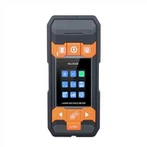
What are the applications of a noise meter?
A sound level meter generally consists of a condenser microphone, preamplifier, attenuator, amplifier, frequency meter network, and effective value indicator head.
The working principle of a sound level meter is:
The sound is converted into an electrical signal by a microphone, and then the impedance is transformed by a preamplifier to match the microphone with an attenuator.
The amplifier adds the output signal to the network, performs frequency weighting on the signal (or an external filter), and then amplifies the signal to a certain amplitude through attenuators and amplifiers before sending it to the effective value detector.
What is a noise meter? And what are the applications of noise meters
There are three standard weighting networks for frequency in noise meters: A, B, and C.
The A network simulates the response of the human ear to a 40 square pure tone in an acoustic curve, and its noise meter curve shape is opposite to the 340 square acoustic curve, resulting in significant attenuation in the middle and low frequency bands of the electrical signal.
B network simulates the response of the human ear to 70 square pure tones, which causes a certain attenuation in the low frequency range of electrical signals.
The C network simulates the response of the human ear to 100 square tones, with a nearly flat response across the entire audio frequency range. The sound pressure level measured by a sound level meter through a frequency weighting network is called sound level;
Depending on the weighting network used, they are referred to as A-level, B-level, and C-level, with units denoted as dB (A), dB (B), and dB (C).
At present, the sound level meter used for measuring noise can be divided into four types of meter responses based on sensitivity:
1. Slow down.
The time constant of the meter head is 1000ms, which is generally used to measure steady-state noise, and the measured value is the effective value.
2. Hurry up.
The time constant of the meter head is 125ms, which is generally used to measure unstable noise and transportation noise with large fluctuations. Fast gear approaches the human ear's response to sound.
3. Pulse or pulse hold.
The rise time of the gauge needle is 35ms, used to measure pulse noise with longer duration, such as punch presses, hammers, etc. The measured value is the effective value.
4. Peak retention.
The rise time of the pointer is less than 20ms. It is used to measure pulse sounds with short duration, such as gun, cannon, and explosion sounds, and the measured value is the peak value That is, the value.