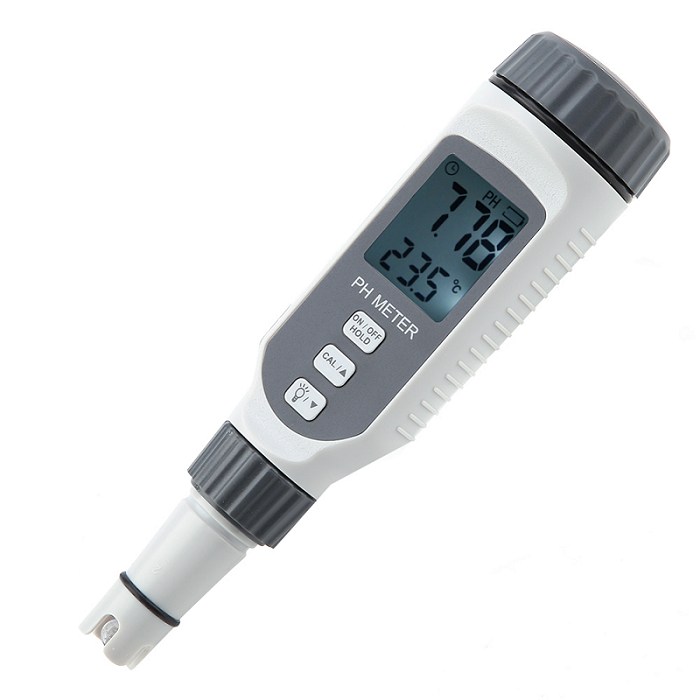
What Are the Common Misunderstandings in Using a pH Meter
1, Measurement parameters of pH meter
Since a pH meter is used to measure the acidity or alkalinity of a solution, it can also be used to measure the concentration of acidic or alkaline solutions. In fact, a pH meter measures the ion activity in a solution, not the concentration of the solution, because the concentration and activity of a solution are different.
2, Automatic compensation function of pH meter
In industrial pH measurement, people often believe that since a pH meter with temperature compensation function is used, no matter how the solution temperature changes, the pH value measured by the pH meter should be at the standard temperature (25 ℃). In fact, the pH meter always measures the pH value at the current temperature. A pH meter with temperature compensation function corrects the slope of electrode potential variation with pH value based on the measured temperature, so as to obtain accurate measurement.
3, Calibration of pH meter
Many people believe that instrument calibration should be carried out within the full range, and the same should be true for pH meters. In fact, it is unrealistic for the electrodes of a pH meter to achieve the same accuracy within the full range during use. The calibration of a pH meter generally adopts two-point calibration. One point is to use a standard buffer solution with a pH of around 7 to locate the pH meter; Another point is to use standard buffer solutions with pH 4 or pH 9 for calibration depending on the usage environment (acidic or alkaline).
Additionally, special attention should be paid to the temperature of the test solution before calibration. In order to select the standard buffer solution correctly and adjust the temperature compensation knob on the electric meter panel to match the temperature of the test solution.
After the calibration work is completed, instruments that are frequently used generally do not need to be recalibrated within 48 hours. If any of the following situations occur, the instrument needs to be recalibrated:
When there is a significant difference between the solution temperature and the calibration temperature;
When the electrode is exposed to air for too long;
3. The positioning or slope adjuster is mistakenly activated;
4. After measuring the solution of acid (pH<2) or alkali (pH<12);
5. After changing the electrode;
When the pH value of the measured solution is not in the middle of the selected solution during two-point calibration, and the distance from 7ph is relatively far.
4, Accuracy level and allowable error of pH meter
Some people believe that in conventional instruments, the accuracy level of the instrument is represented by reference error, and the accuracy level of the pH meter is also the same. In fact, this is a mistaken understanding that the level of a pH meter and the accuracy of the instrument are two different concepts. Its level is represented by the score (resolution or minimum display value) of its indicator (referred to as an electric meter), while the accuracy of the instrument is the comprehensive error of the standard solution tested by the electric meter and the electrode. It is not only related to the electric meter, but also more related to the glass electrode and reference electrode.