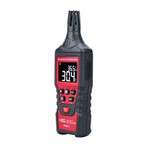
What are the functions of UV light meter
Easy to use: simply connect a new sensor, the host will automatically configure, no need to enter new programs and calibration factors. The detector settings and algorithms are compressed in the device. The detector is ready to use right out of the box.
Remote use: through a 1 or 5 meter cable, it is convenient to measure when the designated place cannot be reached. Model PMA2100 can connect 2 detectors at the same time.
Anti-interference ability: The signal amplification part has been made in the metal box of the detector. The signal is transmitted to the host through the cable, which has a protective function and has high anti-interference ability against EMI and ESD.
Automatic unit conversion: Results are displayed in a variety of commonly used units. Unit selections can be changed with a simple click of a key. Commonly used units and conversion algorithms can be programmed on the detector upon request.
Data record: The host memory can store up to 1024 data. Memory can be started manually or run automatically at user-set intervals (1 minute - 2 hours). A unified record structure applies to all detectors to simplify data management.
Traceability: Each data sample has a series of auxiliary information: date, time, detector type and serial number, current units used, user-set scaling factor, detector calibration date and a series of flags indicating the status of the instrument.
User-Defined Alarms: Independent alarm function for each detector, can monitor instantaneous value or comprehensive metering. Alarm settings are stored within the detector.
Dose synthesis: Dose synthesis can be performed remotely or through the keyboard.
Computer Interface: The collected data can be transferred by connecting to a computer via a serial interface (RS232). Download, display and save data using HyperTerminal in Windows.
Input/Output: The instrument can control independent data input/output. Manipulate the instrument to start or stop metering acquisition, or trigger metering or numerical alarms via outputs.