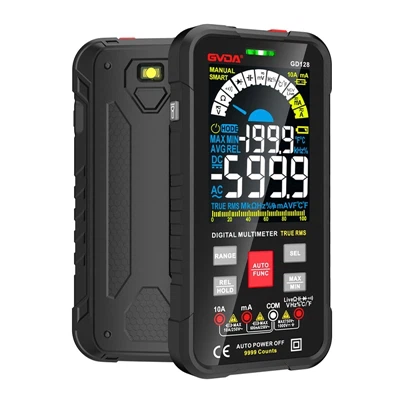
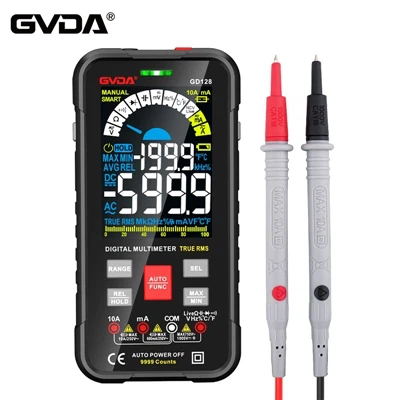
What Are the Types of Effective Values of Multimeters and Their Operating Procedures
The effective value of a multimeter usually refers to one of the following three situations:
1. The method of calibrating the average value, also known as the corrected average value or the rectified average value calibrated to the effective value, is based on the principle of converting an AC signal into a DC signal through rectification and integration circuits, and then multiplying it by a coefficient according to the characteristics of a sine wave. For a sine wave, the result of multiplying by this coefficient is equal to the effective value of the sine wave. Therefore, this method is limited to sine wave testing only.
2. Peak detection method obtains the peak value of an AC signal through a peak detection circuit, and then multiplies it by a coefficient based on the characteristics of a sine wave. For a sine wave, the result of multiplying by this coefficient is equal to the effective value of the sine wave. Therefore, this method is limited to sine wave testing only.
3. The true effective value method uses a true effective value circuit to convert AC signals into DC signals before measurement. This method is applicable for testing the true effective value of any waveform.
Most multimeters use the first two methods. And there are significant limitations on the frequency of the signal.
General maintenance of insulation resistance multimeter
1, General maintenance and upkeep
1) Regularly clean the casing of the instrument with a damp cloth and neutral cleaning agent, and do not use abrasives or solvents. Dirt on the terminals and probe terminals can affect the reading, and cleaning agents can be used to clean the dirt on each terminal.
2) When not in use, press the POWER button to turn off the power, and remove the battery for long-term use.
3) Storage of instruments should avoid moisture, high temperatures, and strong magnetic fields.
2, Replace battery
1) Press the POWER button to turn off the power, and remove the probe or test wire from the terminal to completely disconnect the test wire from the circuit being tested.
2) Remove the two screws from the battery cover and take off the battery cover.
3) Remove the battery from the battery compartment.
4) Replace with 6 AA (AM3/LR6) new batteries (standard capacity approximately 2450mAh).
5) Close the battery cover and install two screws.
3, Replace the fuse
To avoid personal injury or instrument damage caused by electric shock or arc burns, the fuse must be replaced according to the following steps, and only fuses of the same model or electrical specifications can be used for replacement.
1) Press the POWER button to turn off the power, and remove the probe or test wire from the terminal to completely disconnect the test wire from the circuit being tested.
2) Remove the two screws on the battery cover, the two screws on the back cover of the housing, and the one screw on the back of the battery, and then remove the battery cover and the back cover of the housing.
3) Gently pry up one end of the fuse, remove the burnt fuse, and replace it with a fuse of the same model or electrical specification. Ensure that the fuse is securely clamped in the middle of the fuse clip. Insurance specification: F1A240V.
4) After closing the battery cover and the back cover of the housing, tighten the four screws. Do not use the instrument panel until it is locked.
5) Fuses rarely need to be replaced, and blown fuses are almost always the result of operational errors.