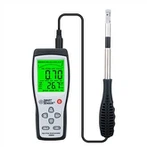
What inspection items should we carry out after purchasing a gas detector?
① Inspect appearance and other items Appearance inspection shall be the first step after receiving a gas detector. It helps identify minor defects arising from transportation, production or assembly. Check the detector surface for flaws, cracks or damage, and verify that all components are intact. Cross-check the model, serial number, manufacturer name and production date marked on the unit against the manual and manufacturer documents to ensure consistency. Confirm that explosion-proof marks, metrological approval marks and corresponding numbers are complete and legible; relevant certificates may be requested from the manufacturer.
② Power-on check Gas detectors rely on power supplies, most commonly built-in batteries. Switch on the unit and confirm normal power-up. Some models operate via replaceable batteries, while others come with dedicated chargers; for charger-equipped units, verify proper charging function. When powered on, check that the display screen works normally.
③ Verify normal sound and light alarm function For gas detectors equipped with sound and light alarms and battery power supply, a distinct audible or visual low-battery indication, different from the gas alarm signal, shall activate when low voltage is detected.
Ⅱ. Indication Error Gas detectors measure gas concentration with a permissible margin of error, and readings outside the specified tolerance mean the instrument fails compliance criteria. The allowable indication error varies by gas type. For example, the indication error for oxygen shall be within ±0.5%VOL.
Ⅲ. Alarm Error Apart from reading deviation, the alarm trigger concentration also has a permitted tolerance. Influenced by multiple factors, the detector may not alarm at an identical concentration every time. Compliance is satisfied as long as the deviation stays within standard limits, and alarm error thresholds differ for various gases. For instance, the alarm error for oxygen is within ±0.1%VOL.
Ⅳ. Response Time Response time refers to the duration required for the detector reading to rise from zero to 90% of its stable final reading. This parameter is subject to standard requirements and differs by gas type, same as indication error and alarm error. The response time for oxygen, for example, shall be ≤20 s.
Ⅴ. Insulation and Withstand Voltage Gas detectors must meet mandatory insulation and withstand voltage criteria: insulation resistance ≥100 MΩ at ambient temperature, and ≥1 MΩ after damp heat treatment. The insulation strength shall withstand 500 V AC for 1 minute without discharge or breakdown. The detector is deemed compliant only if all above requirements are satisfied.