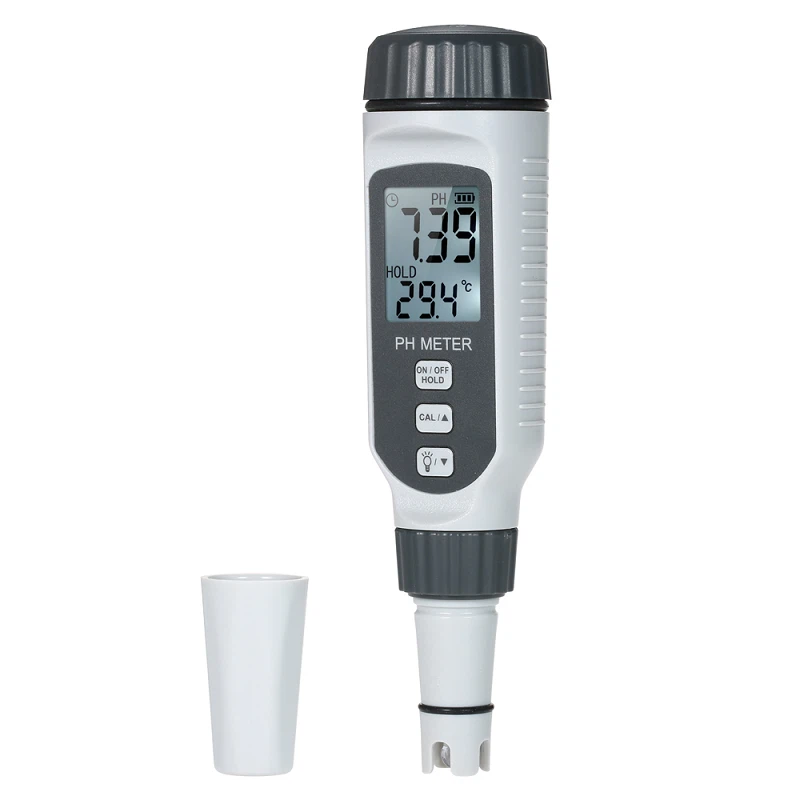
What is pH meter glass electrode:
It consists of glass support rod, glass membrane, internal reference solution, internal reference electrode, electrode cap, wires, etc. Glass support; glass membrane: composed of a glass membrane that is sensitive to hydrogen ions and is composed of special ingredients. The glass membrane is generally in the shape of a bulb; the bulb is filled with an internal reference solution (a mixed solution of neutral phosphate and potassium chloride); an internal reference electrode (usually a silver/silver chloride electrode) is inserted and sealed with an electrode cap Pull out the wire and install the socket to become a pH indicating electrode. The most commonly used indicating electrode sold on the market is the 231 glass pH electrode.
The key part of the glass electrode is a hemispherical spherical glass film connected to the lower end of the glass tube and made of special glass (its composition: the mass fractions of SiO2, Na2O and CaO are 0.72, 0.22 and 0.06 respectively), with a film thickness of 50 μm. A glass film ball is filled with a certain concentration of HCl solution (usually 0.1mol²dm-3 HCI), and a silver wire covered with a thin layer of AgCl is inserted into the HCl solution, and then connected with a wire to form a glass electrode.
When the glass electrode is immersed in the solution to be measured, the inner and outer sides of the glass film swell due to water absorption to form two extremely thin hydration gel layers, while the middle is still a dry glass layer. When measuring pH, ion exchange will occur at the interface between the outside of the glass membrane and the pH solution to be measured, and H+ ions will enter and exit; similarly, the interface between the inside of the glass membrane and the 0.1mol²dm-3 HCI solution inside the membrane will also occur. In ion exchange, H+ ions also enter and exit. Due to the difference in H+ ion concentration in the solution on both sides of the glass membrane and the influence of ion diffusion in the hydration gel layer of the glass membrane, a relatively stable potential difference is gradually established between the two phase interfaces on the outside of the membrane and the inside of the membrane, which is called is the membrane potential. Since C (H+) in the HCl solution on the inside of the membrane = 0.1mol²dm-3, it is a constant value. When the ion diffusion situation in the glass membrane is stable, its impact on the membrane potential is also a constant value, so the membrane potential only depends on the outside of the membrane. The H+ concentration (C(H+)) in the pH solution to be measured. After the membrane potential is combined with the potential of the AgCl-Ag electrode, the electrode potential of the glass electrode is obtained: φ glass electrode = φ0 glass electrode + (2.303RT/2F) ³lg [C (H+)] / C0] 2;