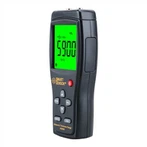
What is pH meter slope
The slope of the PH meter is used by the PH meter to convert the millivolt signal of the electrode into a pH value. It refers to the voltage difference measured with different buffers, divided by the buffer pl difference. The slope in the pH meter is calculated according to the Nernst equation. Generally, the balance does not appear until the slope is calibrated. The slope is an important indicator to determine whether the life of the electrode is exhausted. Generally, there are three levels of electrode life. The slope of a new electrode after calibration is between 95% and 105%. If the slope is lower than 90, it is recommended to replace the electrode, otherwise it will affect its measurement accuracy. pH calibration solution for pH meter calibration. The calculation of the slope is related to the electrode measuring the potential of the solution you prepared. For the three standard buffer solutions, two are usually selected for calibration. If all three buffer solutions are involved in the calibration, the slope will be different accordingly.
A pH meter is an instrument used to measure the pH value of a solution. The pH meter works on the principle of a galvanic battery. The electromotive force between the two electrodes of the galvanic battery is based on Nernst's law, which is related not only to the properties of the electrodes themselves, but also to the concentration of hydrogen ions in the solution. There is a corresponding relationship between the electromotive force of the primary battery and the concentration of hydrogen ions, and the negative logarithm of the concentration of hydrogen ions is the pH value. A pH meter is a common analytical instrument widely used in agriculture, environmental protection and industry. Soil pH is one of the important basic properties of soil. In the process of pH determination, factors such as the temperature and ionic strength of the solution to be tested should be considered.
What is pH? pH is an abbreviation of the Latin word "Pondus hydrogenii" (Pondus=pressure, pressure hydrogenium=hydrogen), which is used to measure the activity of hydrogen ions in a substance. This activity is directly related to the acidity, neutrality and alkalinity of the aqueous solution. Water is chemically neutral, but it is not without ions. Even chemically pure water is slightly dissociated: Strictly speaking, hydrogen nuclei do not exist in a free state before hydration with water molecules.
H2O+ H2O=H3O++ OHˉ, since the concentration of hydronium ion (H3O+) is treated as the concentration of hydrogen ion (H+), the above formula can be simplified into the following common form: H2O=H++ OHˉ
The positive hydrogen ion here is expressed as "H+ ion" or "hydrogen nucleus" in chemistry. Hydronium nuclei are denoted "hydronium ions". Negative hydroxide ions are called "hydroxide ions".
Using the law of mass action, an equilibrium constant can be found for the dissociation of pure water:
K=H3O+×OH-————H2O
Since only a small amount of water is dissociated, the mass molar concentration of water is actually a constant, and there is an equilibrium constant K to obtain the ion product KW of water.
KW=K×H2O KW= H3O+·OH-=10-7·10-7=10-14mol/l(25℃)
That is to say, there are 10-7 moles of H3O+ ions and 10-7 moles of OHˉ ions in one liter of pure water at 25°C.
In a neutral solution, the concentrations of hydrogen ions H+ and hydroxide ions OHˉ are both 10-7mol/l. like:
If there is an excess of hydrogen ions H+, the solution is acidic. An acid is a substance that can dissociate hydrogen ions H+ in an aqueous solution. Likewise, if the OHˉions are freed, then the solution is alkaline. Therefore, giving the H+ value is enough to indicate the characteristics of the solution, whether it is acidic or alkaline. In order to avoid the calculation of the negative power exponent of this molecular concentration, the biologist Soernsen suggested in 1909 that this inconvenient Values are replaced by logarithms and defined as "pH values". Mathematical definition of pH is the common negative logarithm of the hydrogen ion concentration. That is, pH=-log[H+].