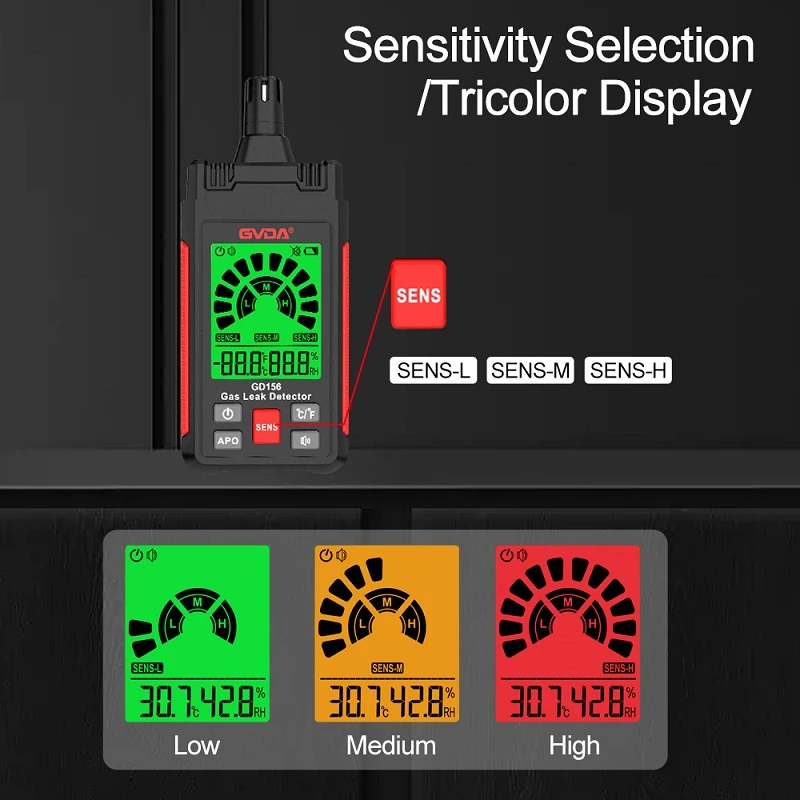
What is the basis for the selection of gas detectors?
The classification of gas detectors is classified according to the detection objects, including flammable gas (including methane) detection and alarm devices, toxic gas detection and alarm devices, and oxygen detection and alarm devices. Classified according to the detection principle, flammable gas detection includes catalytic combustion type, semiconductor type, thermal conductivity type and infrared absorption type, etc.; toxic gas detection includes electrochemical type, semiconductor type, etc.; oxygen detection includes electrochemical type, etc. Classified according to the way of use, there are portable and fixed. Classified according to the place of use, there are conventional type and explosion-proof type. Classified by function, there are gas detectors, gas alarms and gas detection alarms. According to the sampling method, there are diffusion type and pump suction type.
In general, industrial gas detectors have the following advantages: suitable for real-time and accurate detection of gas concentration and leakage in various environments, using imported catalytic combustion, atmospheric monitoring, electrochemical, thermal conductivity, laser, PID, infrared and other sensors and Microcontroller technology. Fast response, high measurement accuracy, good stability and repeatability.
The service life of the gas detector mainly depends on its main component -- the sensor.
We also know that it is impossible to have a sensor that can detect all gases and meet all requirements. The sensors used in various gases and environments are also different, which can be roughly divided into: sensors for detecting the concentration of toxic gases and sensors for Sensors that detect explosive concentrations of flammable gases.
Most of the sensors used to measure the concentration of toxic gases are electrochemical sensors, which work on the basis of electrochemical principles. The main thing that affects their life is the electrolyte. After 2 to 3 years for general sensors, the electrolyte will be exhausted. It works normally, so the service life of the electrochemical sensor is 2 to 3 years.
Most of the sensors used to detect the concentration of combustible gases are catalytic combustion sensors, and their service life is 3 to 5 years.
For example: carbon monoxide is a colorless, tasteless, odorless gas with relative density, slightly soluble in water, and can burn. When the volume concentration reaches 13%~75%, it will be explosive when encountering a fire source. Carbon monoxide is highly toxic. The affinity of heme in human blood to carbon monoxide is 250-300 times greater than its affinity to oxygen. The degree of carbon monoxide poisoning is related to poisoning concentration, poisoning events, breathing frequency and depth, and human constitution. 50ppm: The maximum content allowed for adults to be exposed to it. 200ppm: A few hours later there will be slight poisoning symptoms such as headache, heartbeat, tinnitus. 400ppm: 2h can cause forehead pain, 3h later will be life-threatening. 800ppm: headache and nausea within 45 minutes, death within 2h-3h.