What is the use of multimeter at home
For an electrician, a multimeter can judge almost 80% of the faults. But for the family, there is a multimeter. When the home circuit fails, you can measure the voltage, the on-off, and the resistance to ground, and you can basically deal with the home circuit failure.
With a multimeter at home, there is almost no need to worry about problems with the home circuit. After all, the home circuit is simple, at least you don’t have to worry about accidentally touching the live body. But if you don't have a multimeter at home, it doesn't matter. Because the home circuit is simple, basically there are very few problems.
The use of multimeters in family life is still very large.
1. Measuring the battery
Evaluating whether the battery at home is still charged is a problem that everyone often encounters. Especially some electrical appliances that use more than two batteries, such as remote controls, doorbells, electronic blood pressure monitors, etc. It is often that one of the batteries is out of power, which affects the output of the whole battery pack. If you don't use the meter to test, you may throw away the whole battery pack. Form a lot of waste. Here's how to measure the battery with a multimeter:
① Measuring voltage
First, turn the multimeter to the DC voltage range, and the range selection should be slightly larger than the measured voltage.
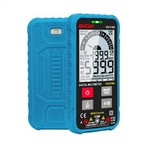
The digital meter on the left selects the 2V of the white number, and the pointer meter on the right selects DCV 2.5v. Then insert the black test lead into the C0M hole, and the red test lead into the "VΩ" hole. When measuring the battery, the digital meter can be read directly, and the pointer meter depends on the scale line with a full scale value of 250 (2.5, 25, and 250 are all used on this scale)
The pointer of the measurement result deflects to the 150 position, which means that the voltage of the battery under test is 1.5V. Batteries with other voltages can also be dialed to the corresponding gear in this way.
② Measuring current
When measuring the battery current, first adjust the test lead jack. Black socket C0M, red socket 5A or 10A hole.
Strictly speaking, it is not allowed to use an ammeter to directly measure the battery. However, for small-capacity dry batteries, a short-term test within a limited range is a shortcut for selecting batteries.
Because some batteries can be tested with voltage files, but it will show that the battery is insufficient when installed on electrical appliances. This is what we usually call "floating electricity" or "virtual electricity". From a professional point of view, it is the internal resistance of the battery that is at fault. For such a battery, it will be "revealed" when measured with an ammeter. For example, to measure the dry batteries of No. 1 to No. 7, you can directly use the DC current file of 5A or 10 A to measure, but the measurement time should not exceed 1 second. Generally speaking, the new No. 7 battery will not be less than 1 amp, while the No. 1 battery will reach more than 5 amps. We can use this method to screen and pair batteries to really make the best use of them. However, the lithium battery of the mobile phone cannot directly measure the current, because there will be no current output due to the protection circuit.
2. Measuring household appliances
For household appliances such as electric kettles, electric heaters and hair dryers, you need to use the Ω file of the multimeter to judge whether they are good or bad.
First turn the multimeter to the Ω file. The digital table is 2K, and the pointer table is Rx10. The scale of the dial can be seen on the one marked with "Ω" on the top, and the pointer reading x10 is enough. Plug the black test lead into C0M, and the red plug into "+" or "ⅤΩ".
①Electric appliances
For electric heaters, electric kettles and hair dryers, etc., when the power is off, turn on the power switch to measure the resistance of the plug. Generally, it is between tens of Ω, which can be considered good.
②Motors
Household motors generally refer to range hoods, exhaust fans, electric fans, refrigerators and small electric drills. The measurement method is also to turn on the power switch to measure the resistance of the two pins of the plug under the condition of no power, generally a few hundred Ω is normal.
The above two resistance value ranges are reference values, the greater the power, the smaller the resistance value. However, it does not include rice cookers with electronic speed regulation and various automatic functions, because its control circuit needs to be powered on to work, and the resistance cannot be measured when the power is off.
③ Various power adapters
To measure the power supply, you need to set the multimeter to the DC voltage range instead of the resistance range. Its gear selection principle is also slightly greater than the measured voltage. Use the test lead to directly measure the output plug of the power adapter, or insert the test lead into the USB socket for measurement:
However, some router adapters have a 9v AC output, which needs to be measured with an AC voltage file.