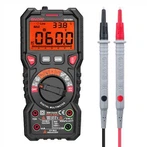
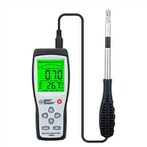
What is the verification of the illuminance meter?
The random measurement errors in the verification process of the illuminance meter mainly include external light interference, changes in temperature and humidity, voltage fluctuations of the regulated DC power supply, vibration during the movement of the standard lamp, and personnel readings.
Among these random measurement errors, some are unavoidable, which requires measures to reduce the impact of errors as much as possible.
The illuminance meter verification environment should be in a dark room with constant temperature and humidity to reduce the influence of external light, temperature and humidity. The illuminance meter should be installed on a stable workbench (there should be no strong magnetic field around it to prevent electromagnetic interference);
The indoor temperature should be kept at (20±5)°C (the drift of the photocell changes with the temperature).
The room should be dry and the humidity should be less than 85%RH. Because the humidity is also affected by the contrast meter;
For this reason, the light probe of the illuminance meter is required to have better sealing performance. For the illuminance meter that has not been used for a long time, it is best to be powered on once in a while.
In order to reduce the impact of vibration caused by the movement of the standard lamp, the light track and the trolley are selected, and slide slowly during the measurement process to reduce the impact of vibration.
As for the problem of personnel readings, it is necessary for the verification personnel to have considerable knowledge of illuminance meter verification and skilled operation skills, and to be conscientious and responsible in the process of lux meter verification.
The specific operation steps of the illuminance meter, the illuminance meter (or called lux meter) is a kind of instrument specially used for measuring luminosity and brightness.
It is to measure the light intensity (illuminance) is the degree to which the object is illuminated, that is, the ratio of the luminous flux obtained by the surface of the object to the illuminated area.
An illuminance meter is usually composed of a selenium photocell or a silicon photocell and a microammeter.
So, what are the specific operation steps of the illuminance meter? Now for everyone to explain in detail:
① Turn on the power.
②Open the cover of the photodetector and place the photodetector horizontally at the measuring position.
③Select the appropriate measurement gear.
If only "1" is displayed at the left end of the display, it means that the illumination is too much, and you need to press the range key (⑧ key) to adjust the measurement multiple.
④The illuminance meter starts to work and displays the illuminance value on the display.
⑤The data displayed on the display screen is constantly changing. When the displayed data is relatively stable, press the HOLD button to lock the data.
⑥Read and record the observed value displayed in the reader. The observed value is equal to the product of the number displayed on the readout and the span value.
For example: 500 is displayed on the screen, the status displayed in the lower right corner is "×2000", and the illuminance measurement value is 1000000lx, that is (500×2000).
⑦Press the lock switch again to cancel the reading lock function.
⑧ For each observation, take three consecutive readings and record them.
⑨After each measurement is completed, press the power switch key to cut off the power supply.
⑩Close the cover of the photodetector and put it back into the box.