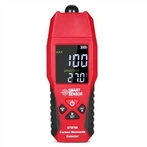
What matters should be paid attention to in the selection of thickness gauge?
Laser thickness gauges are generally used to measure the overall thickness of plates, ultrasonic thickness gauges are generally used to measure the thickness of coatings, and ray thickness gauges are used to measure the thickness of thin plates. The following introduces the selection method of the laser thickness gauge.
Laser thickness gauge detection principle:
The laser probe 1 and the laser probe 2 are arranged at a fixed distance relative to each other. When working, the laser probe 1 emits a laser beam to irradiate the lower surface of the measured object, and the diffuse reflection light of the spot on the lower surface returns to the CCD in the laser probe 1. On the chip, by analyzing and calculating the position of the light spot on the CCD chip, the actual distance from the laser probe 1 to the lower surface of the measured object can be obtained; similarly, the distance from the laser probe 2 to the upper surface of the measured object can be obtained. The thickness of the measured object can be obtained by subtracting the distance between the two measuring heads and the upper and lower surfaces of the measured object from the distance between the two measuring heads.
1. Measuring range
It is necessary to clarify the thickness of each plate produced, and summarize the thickness of each produced plate to obtain the plate range. The detection range of the thickness gauge must meet the thickness of all plates in production, and avoid repeated purchase of multiple thickness gauges.
2. Measurement accuracy
Different types of plates require different precision. The higher the precision requirement, the higher the precision of the probe, and the higher the price. Therefore, it is necessary to clarify the detection accuracy required by oneself in order to select a suitable probe.
3. Application occasions
What plate inspection is the thickness gauge used for, what is the on-site environment, whether the plate is reflective, whether it is detected online, whether the tested rolled material is self-illuminating, cold-rolled or hot-rolled, etc.
4. Detection points
The width of the plate is different, and the requirements for the number of detection points are different. Therefore, it is necessary to specify the number of detection points, and install the appropriate number of probe sets when manufacturing the thickness gauge. In addition to multi-point detection, there is also a scanning thickness gauge for wide plate detection, that is, the C-shaped frame drives the measuring head to move back and forth, and its detection route is "Z"-shaped. Before choosing, you need to clarify your own detection method.
5. Contact or not
The laser thickness gauge is divided into contact detection and non-contact detection. The detection method is selected according to the detection requirements. The non-contact detection can detect the rolling material without damaging it. It can also detect high-temperature and easily deformed rolling materials. Contact Type measurement can only detect some hard plates.
The laser thickness gauge mainly depends on how to choose the model from the above five points. After understanding your own testing needs, it is very necessary to choose a suitable thickness testing device.