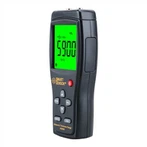
What might be the possible causes for the malfunction of the resistance range of a mechanical multimeter?
If the resistance range of a mechanical multimeter, that is, a pointer multimeter, is damaged while other ranges can be tested normally, it indicates that the meter head is likely not affected. According to the testing principle of the multimeter's resistance range, it is highly probable that the precision shunt and voltage-dividing resistors in the resistance range are burned out or their resistance values have changed. The most likely cause for the damage of the resistance range of a mechanical multimeter is using the resistance range to test the voltage instead of using the voltage range. Therefore, before each test, it is necessary to get into the habit of checking whether the range is correctly selected and develop good testing habits.
If the resistance range of a pointer multimeter is broken while other ranges can still be used, it shows that the meter head of the multimeter is in good condition. This is caused by incorrect usage. There are two reasons for this. First, when the multimeter is set to the DC current range and used to measure the AC 220V voltage, several small-resistance wire-wound resistors in the current range will be burned out. (Regardless of the model of the pointer multimeter, these resistors are all wire-wound resistors, made of constantan resistance wire and have very small resistance values. However, since the multimeter mentioned by the questioner only has a problem with the resistance range, there is no issue in this regard.)
The second reason is that for beginner electronics and electrical workers, after using the resistance range of the multimeter to measure components or check the circuit, they fail to switch the multimeter range to the AC 500V range, and then test the alternating current in the 220V AC circuit or socket.
① The MF - 47 multimeter has a direct - current amperage range (DCA), which includes a total of five commonly - used ranges and an additional extended jack for a large current of 5A, with values ranging from 0 to 0.05mA, 0.5mA, 5mA, 50mA, to 500mA.
② It has eight commonly - used ranges for direct - current voltage (DCV) and an additional extended jack that can measure DC 2500V. The voltage ranges from 0 to 0.25V, 1V, 2.5V, 10V, 50V, 250V, 500V, 1000V, to 2500V.
③ There are six ranges for alternating - current voltage (ACV), with values of 0, 10V, 50V, 250V, 500V, and 2500V.
④ It has five ranges for the direct - current resistance range (Ω), namely R×1Ω, R×10Ω, R×100Ω, R×1KΩ, and R×10KΩ. There is also a buzzer for measuring circuit continuity (when the circuit resistance is between 3 - 10Ω, the buzzer will emit a prompt sound). Due to limited space, functions such as the DC amplification factor hFE of transistors, the detection of infrared remote - control emission signals, and audio - level DB are omitted.
First, when using the resistance range for measurement, the black test lead is inserted into a socket, then it connects to the negative pole of the meter head. There are 20.2Ω, 220.4Ω, and 2430Ω resistors, all of which are in parallel with the meter head. At this time, the red test lead is inserted into the "+" socket of the multimeter. It passes through a 1A fuse, then an AA battery in series with a resistor, and then through a 20k resistor, a 1.7k variable potentiometer for zero - adjustment of the resistance range, a 500Ω resistor, another meter - head calibration resistor R+, and finally reaches the positive pole "+" of the meter head. Once you understand the closed - loop circuit, it will be easier. Based on personal experience, you can trace the circuit to find potential problems.