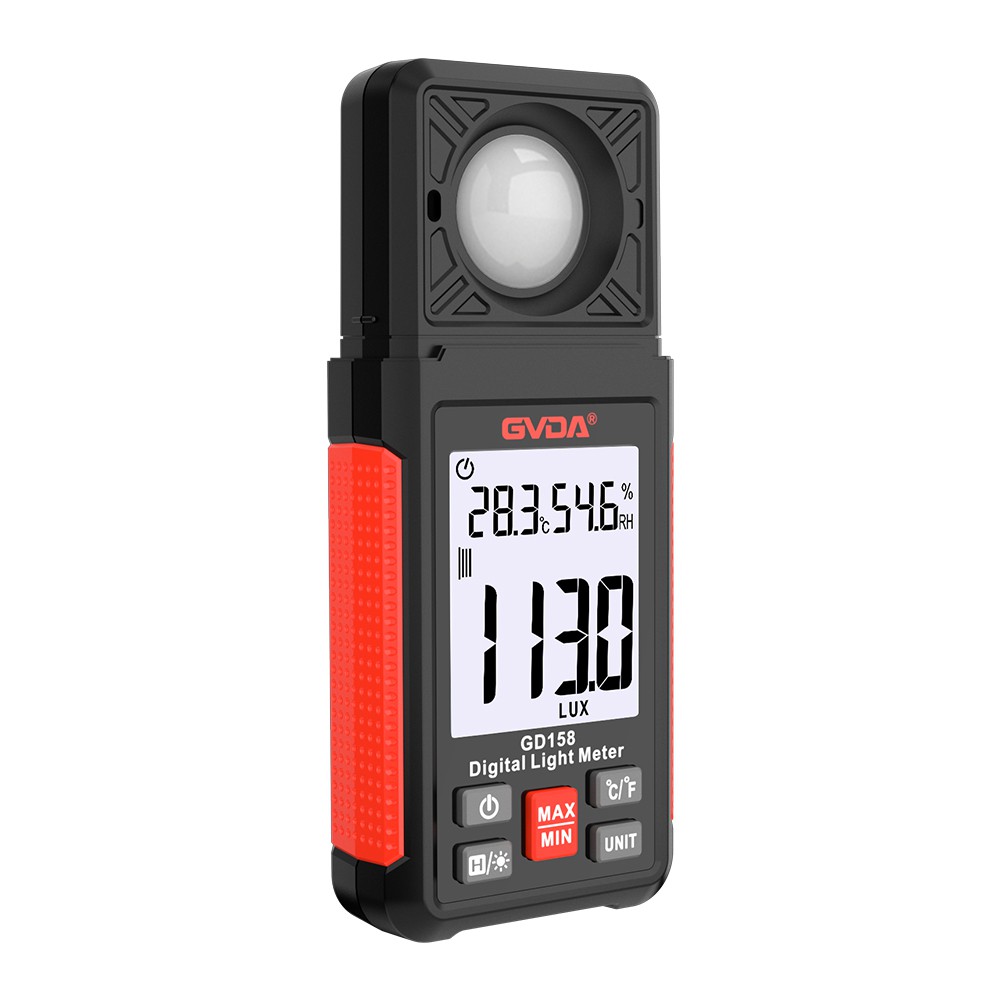
When using the UV light meter, be mindful of the local temperature.
When using, care must be taken to avoid receiving strong light, because the cathode of the phototube will be fatigued if it is exposed to strong light for a long time, which will cause the photocathode to emit abnormally. Therefore, the protective cover of the window should be covered when the illuminance meter is not used. In addition, the ambient temperature of the ultraviolet illuminance meter should not be very high or low. Especially the ultraviolet illuminance meter that uses thermoelectric effect elements as the receiver has stricter requirements on the ambient temperature (generally at 20°C); and when the photoelectric cell GD-5 is used as the receiver, the requirements on the ambient temperature are not very strict. Generally speaking, the lower the temperature, the better; to reduce the dark current. In addition, when measuring the radiation of the light source, it should be perpendicular to the window of the receiver. If it is tilted, it will produce a large error. Angle correction is required at this time.
Types of illuminance meters involved
1. Visual illuminance meter: inconvenient to use, low accuracy, rarely used
2. Photoelectric illuminance meter: commonly used selenium photocell illuminance meter and silicon photocell illuminance meter
The composition and use requirements of the photoelectric illuminance meter:
1. Composition: Microammeter, shift knob, zero point adjustment, terminal, photocell, V(λ) correction filter, etc.
Commonly used selenium (Se) photocell or silicon (Si) photocell illuminance meter, also known as lux meter
2. Requirements for use:
The light meter probe is made of glass, which is easy to break and break, and the waterproof effect is poor when used
① Photocells should use selenium (Se) photocells or silicon (Si) photocells with good linearity; they can still maintain good stability and high sensitivity after working for a long time; when E is high, choose photocells with high internal resistance, which have low sensitivity and good linearity , not easily damaged by strong light
② There is a V(λ) correction filter inside, which is suitable for the illumination of light sources with different color temperatures, and the error is small
③Add a cosine angle compensator (opalescent glass or white plastic) in front of the photocell because when the incident angle is large, the photocell deviates from the cosine rule
④ The illuminance meter should work at room temperature or close to room temperature (photocell drift changes with temperature)