Why is the efficiency of linear power supply relatively low
1. Explain how the switching power supply works by giving examples. The working principle of the switching power supply.
2. By giving an example the difference between the working mode of switching power supply and the working mode of linear power supply.
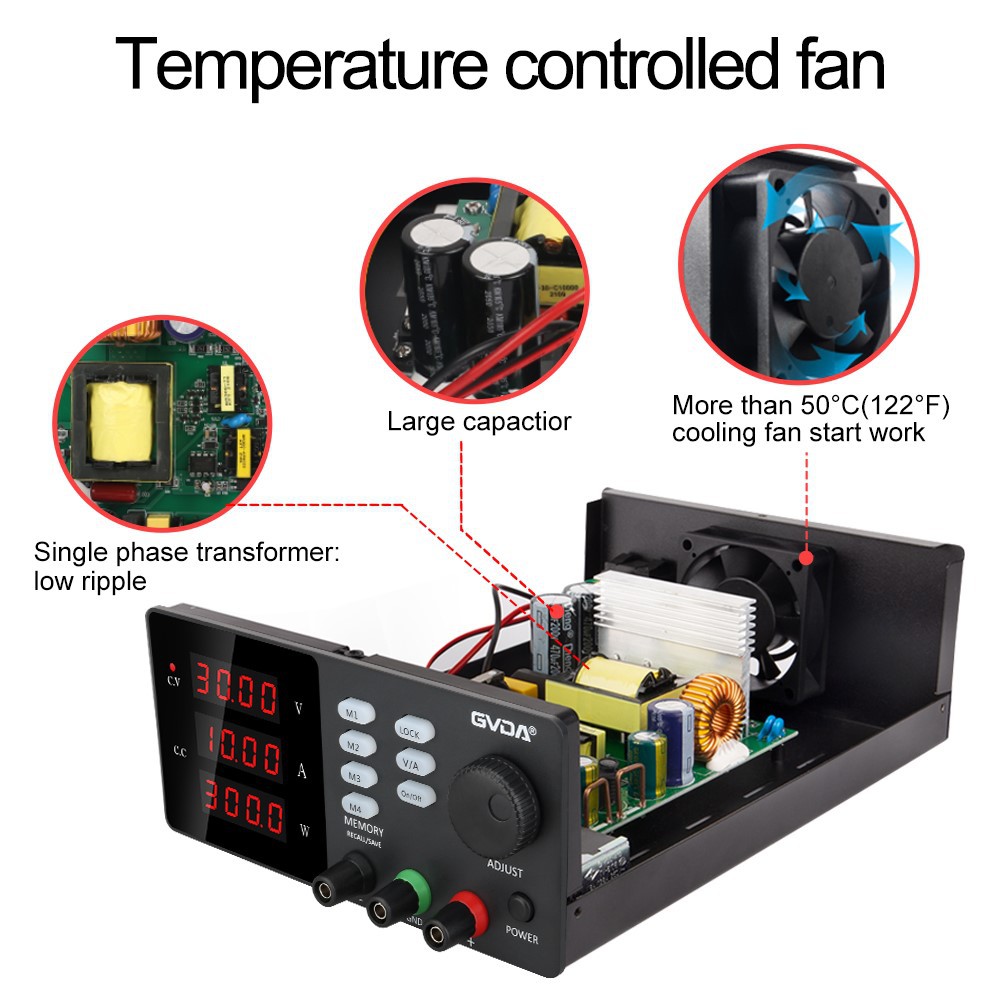
3. Analyze and explain why the efficiency of linear power supply is relatively low, while the efficiency of switching power supply is relatively high?
4. Explain how the switching power supply achieves energy transfer? And how to achieve stable voltage output? How to adjust? Why do changes in input voltage and load affect regulation? Why are there ripples? Why is speed response Is it an important indicator to measure switching power supply?
5. Analyze in detail how the switching loss is generated? How to control the temperature rise? What harm does the temperature rise do to the system?
6. The relationship between the volume and frequency of switching power supply? And the efficiency of switching power supply.
7. How to choose switching devices? Analyze the advantages and disadvantages of MOSFET, IGBT and triode in detail.
8. The process of deriving the BUCK circuit topology of the switching power supply in detail.
9. Introduce important components in important analog circuits: inductors.
10. Explain in detail the formation and formula calculation of the inductor voltage. What parameters affect the inductor voltage? How to change the voltage across the inductor?
11. Explain in detail the relationship between the inductor voltage, the magnitude of the current in the inductor, and the rate of change of the current. Why is the magnitude of the inductor current continuous but the rate of change of the current is discontinuous?
12. Explain in detail the three modes of the current waveform in the inductor.
13. Why is it said that the inductor current changes after power on and off? What is its underlying root cause?
14. How to realize the energy conservation of the inductor? Why do we say that only when the inductor current reaches a steady state can it be used for us? How can the change of the inductor current be controlled?
15. Explanation of proper nouns in BUCK circuit to understand the influence of key parameters on design.
16. Explain in detail the derivation of the duty cycle formula.
17. Explain in detail the derivation process of the inductance parameter calculation formula.
18. Several major summaries of BUCK topology.
19. Give an example of an actual case to calculate the inductance parameter on site.
20. Explain in detail the functional modules inside the power control chip.
21. Through the actual demonstration, measure the related waveforms with an oscilloscope on site and analyze and debug them.
Suitable for study groups:
1. If you are still a student, you are tired of boring classroom theory courses and want to gain practical experience in electronic technology research and development;
2. If you are about to graduate or have already graduated, you want to accumulate some experience in design and R&D to stand out from the fiercely competitive employment force and find a high-paying job that belongs to your ideal;
3. If you are already working, but you are worried about the slow improvement of skills, and you cannot get a salary increase and rapid promotion in the company;
4. If you are tired of your current job and want to quickly become an electronic R&D engineer to engage in enviable R&D work.
Column course 23 hours (click on the tutorial to watch)