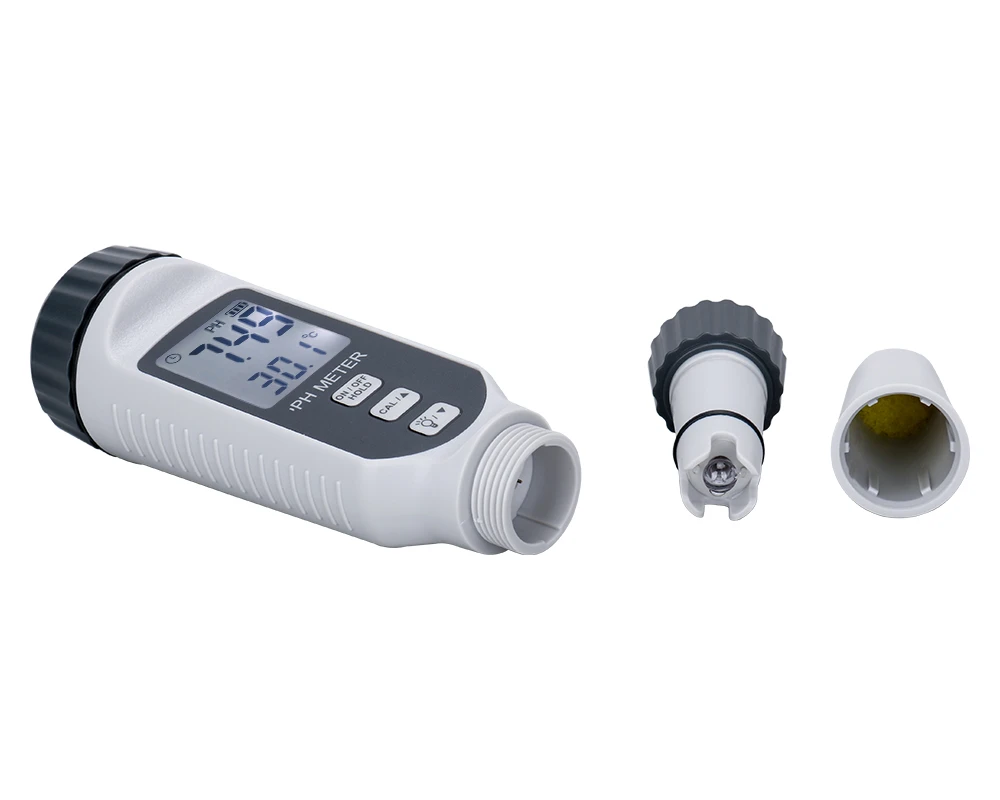
Working Principles of pH Meter and Dissolved Oxygen Analyzer
1. Working principle of pH meter
The pH value of water depends on the amount of dissolved substances, so pH value can sensitively indicate changes in water quality. The change in pH value has a significant impact on the reproduction and survival of organisms, and also seriously affects the biochemical process of activated sludge, which affects the treatment effect. The pH value of sewage is generally controlled between 6.5 and 7. Water is chemically neutral, and some water molecules spontaneously decompose according to the following formula: H2O=H++OH -, which decomposes into hydrogen ions and hydroxide ions. In a neutral solution, the concentrations of hydrogen ion H+and hydroxide ion OH - are both 10-7mol/l, and the pH value is the negative logarithm of the hydrogen ion concentration with a base of 10: pH=- log. Therefore, the pH value of a neutral solution is equal to 7. If there is an excess of hydrogen ions, the pH value is less than 7 and the solution is acidic; On the contrary, if there is an excess of hydroxide ions, the solution becomes alkaline.
The pH value is usually measured by potentiometry, using a constant potential reference electrode and a measuring electrode to form a primary cell. The magnitude of the electromotive force of the primary cell depends on the concentration of hydrogen ions and the acidity or alkalinity of the solution. The factory uses pH sensors and pH transmitters. There is a special glass probe on the measuring electrode that is sensitive to pH reaction. It is made of a special glass that can conduct electricity and penetrate hydrogen ions, and has the characteristics of high measurement accuracy and good anti-interference. When the glass probe comes into contact with hydrogen ions, a potential is generated. The potential was measured using a silver wire suspended in a silver chloride solution as a reference electrode. Different pH values result in different potentials, which are converted into standard 4-20mA outputs through a transmitter.
2. Working principle of dissolved oxygen analyzer
The oxygen content in water can fully demonstrate the degree of self purification of water. For biological treatment plants that use activated sludge, it is important to understand the oxygen content in the aeration tank and oxidation ditch. An increase in dissolved oxygen in wastewater can promote biological activities other than anaerobic microorganisms, thereby removing volatile substances and easily oxidizable ions, and purifying the wastewater. There are three main methods for measuring oxygen content: automatic colorimetric analysis and chemical analysis measurement, paramagnetic measurement, and electrochemical measurement. The dissolved oxygen in water is generally measured by electrochemical method.
Oxygen can dissolve in water, and its solubility depends on temperature, total and partial pressure on the water surface, and the salts dissolved in the water. The higher the atmospheric pressure, the greater the ability of water to dissolve oxygen, which is determined by Henry's law and Dalton's law. Henry's law states that the solubility of a gas is proportional to its partial pressure.