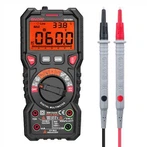
A simple analysis of the principle of the buzzer gear of the digital multimeter
Measuring resistance, capacitance, and relays does not use the beep position of the multimeter. The beep position of the digital multimeter is only a position for measuring the continuity of the line, while measuring resistance requires the use of resistance. The resistance gear is needed, and the various gears perform their duties, not only the buzzer gear is used for measurement.
The buzzer gear of the digital multimeter is realized through the cooperation of the resistance gear and the buzzer drive circuit. In this gear, when the resistance is less than a certain value (usually 50Ω), the buzzer will sound, and the buzzer will sound when it is greater than this value. No sound will be produced.
When the resistance value of the tested line is less than a certain value, the potential of the inverting input terminal of the comparator is pulled down, the potential of the non-inverting input terminal is greater than the potential of the reverse input terminal, and the comparator outputs a high level, thereby driving the buzzer to sound, while When the measured resistance is greater than a certain value, the potential of the reverse input terminal is greater than that of the non-inverting input terminal, the comparator outputs a low level, and the buzzer does not sound.
Since the buzzer position of the digital meter shows the resistance value, it can measure the resistance of small resistance value, such as the resistance between 0Ω and hundreds of Ω, and use this position to measure the coil resistance of some small electromagnetic relays. Another situation is to measure some small-capacity chip capacitors. Using this gear is mainly to simply judge whether the capacitor is short-circuited, but the actual capacity needs to be measured with the capacitor gear.
Which is stronger in anti-interference, digital multimeter or pointer multimeter?
The earliest used pointer multimeter, when using, for example, the resistance gear sometimes needs to be zeroed. When measuring the voltage, start measuring from the high-grade position first to prevent the meter from burning. In addition, it needs to be kept stable when measuring. Dial face. Subject to human and environmental interference.
On the other hand, digital multimeters do not have the above-mentioned disadvantages, and the daily input impedance is large, so there is no need to worry about burning the meter.
But the pointer multimeter has an advantage, it is intuitive when measuring parameters.
The digital multimeter has relatively low requirements for the use environment, a wide range of applications, strong anti-interference ability, and intuitive parameters.
The analog multimeter has a large volume, is inconvenient to carry, has high requirements for the use environment, has poor anti-interference ability, and is inconvenient to read the readings, but has high accuracy.
Of course, the anti-interference ability is better than the pointer multimeter. When the digital multimeter measures some electrical parameters, such as the voltage of some points inside the frequency converter, the reading will jump around, and there is no way to read it. The pointer multimeter does not have this problem, but it is accurate and easy to use. The degree is worse than the digital table. In short, both have their own advantages and disadvantages.
There are two types of pointer watches: internal magnetism and external magnetism. The error caused by static electricity is too large. If you don’t believe me, rub the hands on the dial glass and the hands will not return. Digital watches are useful, but each has its own advantages and disadvantages.