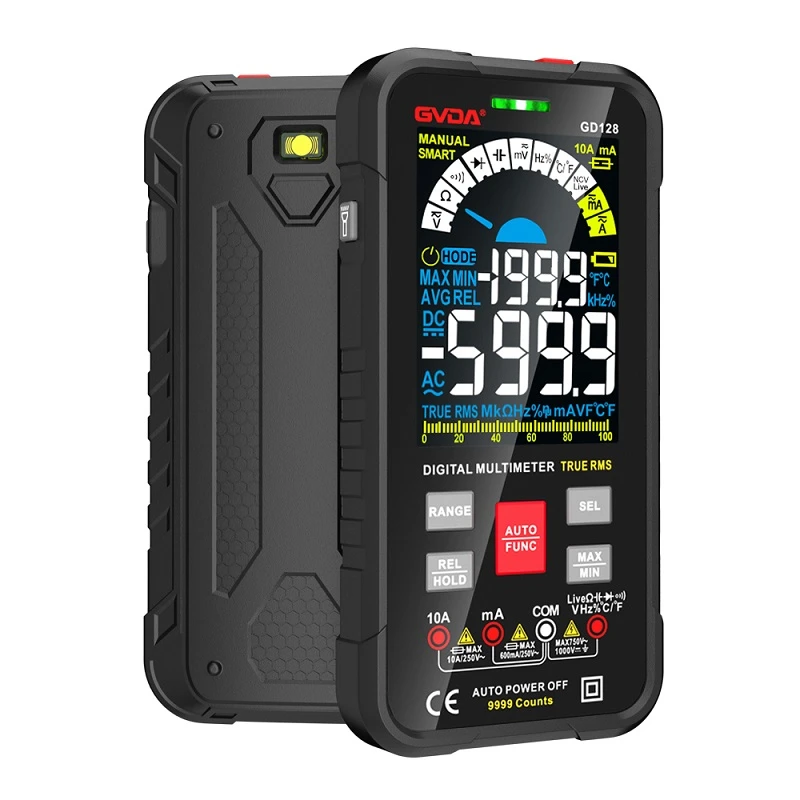
Classification and operation instructions of digital multimeter
Classification of digital multimeters
Digital multimeters are classified according to the range conversion method, which can be divided into three types: manual range (MAN RANGZ), automatic range (AUTO RANGZ), and automatic/manual range (AUTO/MAN RANGZ).
According to different functions, uses and prices, digital multimeters can be roughly divided into 9 categories:
Low-end digital multimeters (also known as popular digital multimeters), mid-range digital multimeters, medium/high-end digital multimeters, digital/analog hybrid instruments, instruments with dual digital/analog displays, universal oscilloscopes (digital multimeters, digital storage oscilloscope and other kinetic energy in one).
Test function of digital multimeter
The digital multimeter can not only measure DC voltage (DCV), AC voltage (ACV), DC current (DCA), AC current (ACA), resistance (Ω), diode forward voltage drop (VF), transistor emitter current amplification factor ( hrg), can also measure capacitance (C), conductance (ns), temperature (T), frequency (f), and added a buzzer file (BZ) for checking the continuity of the line, low power method to measure resistance file (L0Ω). Some instruments also have inductance gear, signal gear, AC/DC automatic conversion function, and capacitance gear automatic range conversion function.
Most digital multimeters have added the following novel and practical test functions: reading hold (HOLD), logic test (LOGIC), true effective value (TRMS), relative value measurement (RELΔ), automatic shutdown (AUTO OFF POWER), etc.
Anti-interference ability of digital multimeter
Simple digital multimeters generally use the integral A/D conversion principle,
As long as the forward integration time is selected to be exactly equal to the integral multiple of the period of the cross-frame interference signal, the cross-frame interference can be effectively suppressed. This is because the cross-frame interference signal is averaged out in the forward integration stage. The common frame rejection ratio (CMRR) of middle and low-end digital multimeters can reach 86-120dB.
Development Trend of Digital Multimeter
Integration: The handheld digital multimeter uses a single-chip A/D converter, and the peripheral circuit is relatively simple, requiring only a few auxiliary chips and components. With the advent of dedicated chips for single-chip digital multimeters, a fully functional automatic range digital multimeter can be formed using a single IC, which creates favorable conditions for simplifying design and reducing costs.
Low power consumption: new digital multimeters generally use CMOS large-scale integrated circuit A/D converters, and the power consumption of the whole machine is very low.
Comparison of the advantages and disadvantages of ordinary multimeters and digital multimeters:
Both analog and digital multimeters have advantages and disadvantages.
The pointer multimeter is an average meter, which has an intuitive and vivid reading indication. (The general reading value is closely related to the swing angle of the pointer, so it is very intuitive).
A digital multimeter is an instantaneous meter. It takes 0.3 seconds to fetch
One sample is used to display the measurement results, sometimes the results of each sampling are very similar, not exactly the same, which is not as convenient as the pointer type for reading the results. The pointer multimeter generally does not have an amplifier inside, so the internal resistance is small.
Due to the internal use of the operational amplifier circuit in the digital multimeter, the internal resistance can be made very large, often 1M ohms or greater. (ie higher sensitivity can be obtained). This makes the impact on the circuit under test can be smaller, and the measurement accuracy is higher.
Due to the small internal resistance of the pointer multimeter, discrete components are often used to form a shunt and voltage divider circuit. Therefore, the frequency characteristics are uneven (compared to the digital type), and the frequency characteristics of the digital multimeter are relatively better. The internal structure of the pointer multimeter is simple, so the cost is lower, the function is less, the maintenance is simple, and the overcurrent and overvoltage ability is strong.
The digital multimeter uses a variety of oscillation, amplification, frequency division protection and other circuits inside, so it has many functions. For example, you can measure temperature, frequency (in a lower range), capacitance, inductance, make a signal generator, and so on.
Since the internal structure of the digital multimeter uses integrated circuits, the overload capacity is poor, and it is generally not easy to repair after damage. DMMs have low output voltages (usually no more than 1 volt). It is inconvenient to test some components with special voltage characteristics (such as thyristors, light-emitting diodes, etc.). The pointer multimeter has a higher output voltage. The current is also large, and it is convenient to test thyristors, light-emitting diodes, etc.
A pointer multimeter should be used for beginners, and two meters should be used for non-beginners.
selection principle
1. The reading accuracy of the pointer meter is poor, but the process of the pointer swing is more intuitive, and its swing speed range can sometimes objectively reflect the size of the measured (such as measuring the slight jitter); the reading of the digital meter is intuitive, but the process of digital change looks messy and not easy to watch.
2. There are generally two batteries in the pointer meter, one is low voltage 1.5V, the other is high voltage 9V or 15V, and the black test lead is positive terminal relative to the red test lead. Digital meters usually use a 6V or 9V battery. In the resistance mode, the output current of the test pen of the pointer meter is much larger than that of the digital meter. The loudspeaker can make a loud "da" sound with the R×1Ω gear, and the light-emitting diode (LED) can even be lit with the R×10kΩ gear.
3. In the voltage range, the internal resistance of the pointer meter is relatively small compared with the digital meter, and the measurement accuracy is relatively poor. Some occasions with high voltage and micro current cannot even be measured accurately, because its internal resistance will affect the circuit under test (for example, when measuring the acceleration stage voltage of a TV picture tube, the measured value will be much lower than the actual value). The internal resistance of the voltage range of the digital meter is very large, at least in the megohm level, and has little effect on the circuit under test. However, the extremely high output impedance makes it susceptible to the influence of induced voltage, and the measured data may be false in some occasions with strong electromagnetic interference.
4. In short, pointer meters are suitable for the measurement of analog circuits with relatively high current and high voltage, such as TV sets and audio amplifiers. It is suitable for digital meters in the measurement of low-voltage and low-current digital circuits, such as BP machines, mobile phones, etc. Not perfect, pointer table and digital table can be selected according to the situation.
operating procedures
1. Before use, you should be familiar with the functions of the multimeter, and correctly select the gear, range and test lead jack according to the object to be measured.
2. When the size of the measured data is unknown, the range switch should be set to the maximum value first, and then switch from the large range to the small range, so that the indicator pointer of the instrument is above 1/2 of the full scale.
3. When measuring resistance, after selecting the appropriate magnification, touch the two test leads so that the pointer points to the zero position. If the pointer deviates from the zero position, adjust the "zero adjustment" knob to make the pointer return to zero to ensure accurate measurement results. . If it cannot be adjusted to zero or the digital display meter sends out a low voltage alarm, it should be checked in time.
4. When measuring the resistance of a certain circuit, the power supply of the circuit under test must be cut off, and live measurement is not allowed.
5. When using a multimeter to measure, pay attention to the safety of the person and the instrument. Do not touch the metal part of the test pen with your hands during the test. It is not allowed to switch the gear switch with power on to ensure accurate measurement and avoid electric shock and burnout of the instrument. the accident.