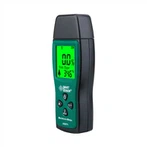
How to use a multimeter to detect the leakage of live wire or neutral wire
Commonly used multimeters are divided into pointer multimeters and digital multimeters; most pointer multimeters do not have gears for measuring AC current, so there is no way to directly measure leakage current; digital multimeters have AC current measurement gears, so it is It is completely possible to measure the leakage value of the power supply line; if there is a digital clamp meter, it is most convenient to measure the leakage current.
Leakage range There are two types of line leakage and electrical equipment leakage;
①Line leakage refers to the leakage current that forms a loop with the earth due to the reduced insulation performance of the line itself when the load in the line is not powered on.
②Electrical equipment leakage refers to the leakage current formed by the insulation resistance between the coils inside the equipment and the earth after the equipment is powered on.
No matter what kind of multimeter, the insulation resistance value of the measured line is not standard (the insulation resistance value of the measured line must be a special megohmmeter), even if you use a multimeter to measure the insulation resistance value of the line, it is only a reference value , and it differs greatly from the actual insulation resistance value; because the multimeter itself is a 9V stacked battery, only a 9V DC voltage is applied to the line measurement, while the voltage of the AC power supply line is 220V and 380V.
If you are using a digital multimeter, you can turn the multimeter to the AC current range.
(1) Line leakage is relatively simple to measure. The current measured by the multimeter is connected in series in the line or equipment. When the line is not connected to the power supply of the load, it is directly connected in series at the lower end of the output of the power supply circuit breaker (need to disengage the line connector). In the circuit breaker output and line connector, notice that the ordinary digital multimeter has just set the current gear to a higher level. The multimeter I use in the picture above is an automatic switching range. The current value measured at this time is the leakage current in the line.
Leakage measurement of electrical equipment is very troublesome, because the installation of electrical equipment shells is basically grounded by mechanical devices. If a multimeter is used to measure leakage, the electrical equipment needs to be vacated. When the equipment is powered on, one end of the multimeter is connected to the ground. One end is in contact with electrical equipment, and the current measured by the multimeter at this time is the leakage current.
(2) How to use a digital multimeter to measure the live wire in the line? First, turn the digital multimeter to the AC ~ 750V gear, use the red test lead line or the black test lead line of the multimeter, and wrap 3 to 5 circles on your own hands. The other test lead is inserted into or contacts the metal post or socket of the conductor.
This is the principle that the contact between the wire and the human body will form a distributed capacitance (the more the number of conductor turns, the greater the capacitance formed with the human body), and the sensitivity of the digital multimeter itself is higher than that of the pointer multimeter. So the response to the display value of the digital multimeter is larger.
The above 1 is a measurement method that I often use. Generally, I wind it 4 times on my hand. At this time, the measurement result is ~57V. There is no doubt that it is the live wire. The test lead line wound on the hand does not move, and then use the black test lead to touch the other ground wire N and PE protection ground respectively.
So this is the principle that the contact between the wire and the human body will form distributed capacitance (the more the number of conductor turns, the greater the capacitance formed with the human body), and the sensitivity of the digital multimeter itself is higher than that of the pointer multimeter. So the response to the display value of the digital multimeter is larger.
The above 1 is a measurement method that I often use. Generally, I wind it 4 times on my hand. At this time, the measurement result is ~57V. There is no doubt that it is the live wire. The test lead line wound on the hand does not move, and then use the black test lead to touch the other ground wire N and PE protection ground respectively.
At this time, the measurement result of the digital multimeter is displayed as 000, which means that the live wire, neutral wire, and PE protective grounding in the line have all been detected.