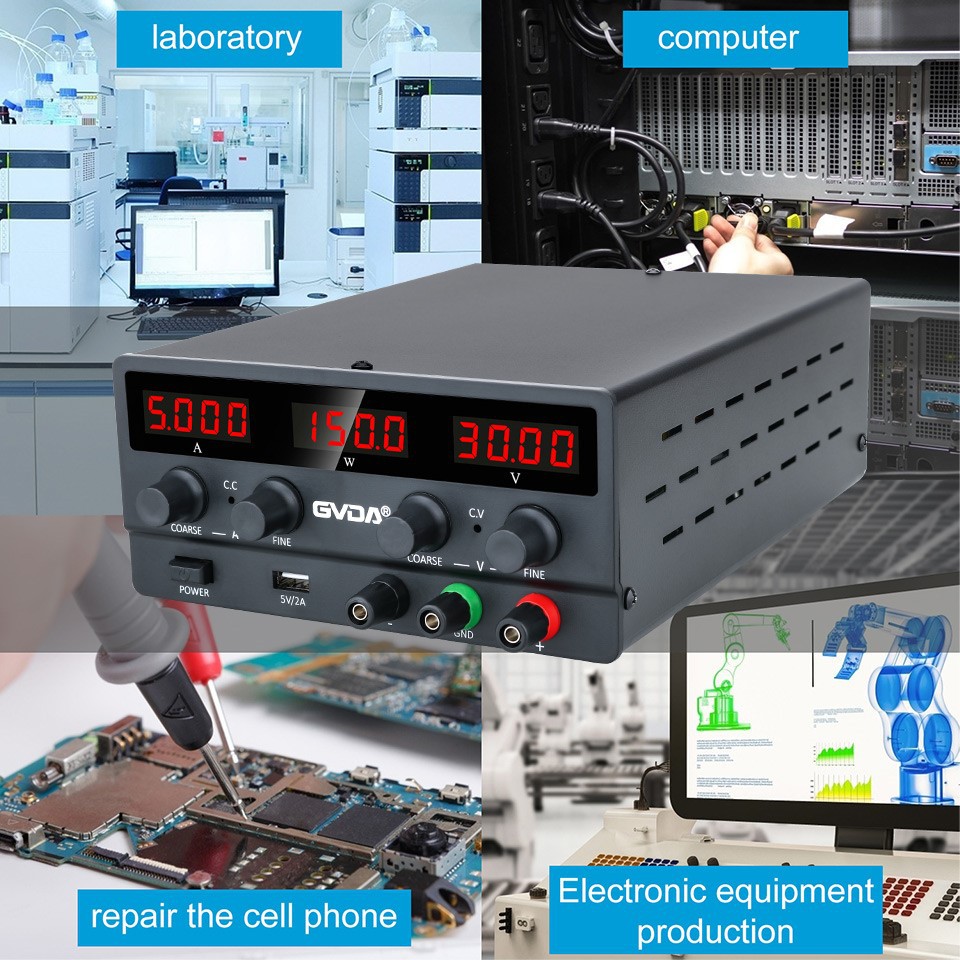
Operating Principle of Switching Power Supply
The working process of switching power supply is quite easy to understand, in linear power supply, let the power transistor work in linear mode, unlike linear power supply, pWM switching power supply is to let the power transistor work in the on-state and off-state, in these two states, the volt-ampere product added to the power transistor is very small (in the on-state, the voltage is low, and the current is large; in the off-state, the voltage is high, and the current is small) / power device The volt-ampere product on the power transistor is the loss incurred on the power semiconductor device. Compared to linear power supplies, pWM switching power supplies work more efficiently by "chopping", i.e., chopping the input DC voltage into pulses with an amplitude equal to the amplitude of the input voltage. The duty cycle of the pulse is adjusted by the controller of the switching power supply. Once the input voltage is chopped into an AC square wave, its amplitude can be raised or lowered by the transformer. The number of output voltage groups can be increased by increasing the number of secondary windings in the transformer. Finally these AC waveforms are rectified and filtered to obtain the DC output voltage. The main purpose of the controller is to keep the output voltage stable, and its working process is very similar to that of a linear form of controller. This means that the functional blocks of the controller, the voltage reference and the error amplifier, can be designed in the same way as in a linear regulator. The difference is that the output of the error amplifier (the error voltage) passes through a voltage/pulse width conversion unit before driving the power tubes. Switching power supplies have two main modes of operation: forward conversion and boost conversion. Although the differences in the arrangement of their components are small, the operating processes vary considerably, and each has its own advantages for a particular application.
Three conditions for switching power supplies
Switching
Power electronics operating in a switching state rather than a linear state.
High frequency
Power electronics operate at a high frequency rather than at a low frequency close to the industrial frequency.
DC
Switching power supplies output DC instead of AC or they can output high frequency AC such as electronic transformers.
Classification of switching power supplies
People in the field of switching power supply technology is the side of the development of related power electronic devices, while the development of switching inverter technology, the two promote each other to promote the switching power supply to more than double-digit annual growth rate toward the light, small, thin, low noise, high reliability, anti-jamming direction of development. Switching power supply can be divided into AC / DC and DC / DC two categories, there are also AC / ACDC / AC such as inverter DC / DC converter has now achieved modularity, and the design technology and production processes at home and abroad have matured and standardized, and has been recognized by the user, but the modularity of the AC / DC, because of its own characteristics make the process of modularization, encountered a more complex technology and process manufacturing Problems. The structure and characteristics of the two types of switching power supplies are described below.