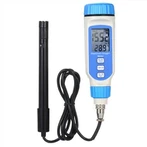
Several Principles for Selecting Multimeter
1. Function
In addition to the five functions of measuring AC and DC voltage, AC and DC current, and resistance, the digital multimeter also has digital calculation, self-test, reading hold, error readout, diode detection, word length selection, IEEE-488 interface or RS-232 interface and other functions should be selected according to specific requirements.
2. Range and range
DMMs come in many ranges, but the basic range is the most accurate. Many digital multimeters have automatic range function, no need to manually adjust the range, making the measurement convenient, accurate and fast. There are also many digital multimeters with over-range capability. When the measured value exceeds the range but has not reached the maximum display, it is not necessary to change the range, thereby improving the accuracy and resolution.
3. Accuracy
The maximum error allowed by the digital multimeter depends not only on its variable error, but also on its fixed error. When choosing, it depends on how much the stability error and linearity error are, and whether the resolution meets the requirements. If the general digital multimeter requires 0.0005 to 0.002, at least 61 digits should be displayed; 0.005 to 0.01, at least 51 digits should be displayed; 0.02 to 0.05, at least 41 digits should be displayed; 0.1 Below, at least 31 digits should be displayed.
4. Input resistance and zero current
If the input resistance of the digital multimeter is too low and the zero current is too high, it will cause measurement errors. The key depends on the limit value allowed by the measuring device, that is, the internal resistance of the signal source. When the signal source impedance is high, an instrument with high input impedance and low zero current should be selected so that its influence can be ignored.
5. Series mode rejection ratio and common mode rejection ratio
In the presence of various disturbances such as electric fields, magnetic fields and various high-frequency noises or long-distance measurements, it is easy to mix in interference signals and cause inaccurate readings. Therefore, instruments with high string and common-mode rejection ratios should be selected according to the use environment, especially When performing high-precision measurement, you should choose a digital multimeter with a protection terminal G, which can well suppress common-mode interference.
6. Display form and power supply
The display form of the digital multimeter is different from numbers, and it can also display charts, text and symbols, so as to facilitate on-site observation, operation and management. According to the dimensions of its display devices, it can be divided into four categories: small, medium, large and super large.
The power supply of the digital multimeter is generally 220V, and some new digital multimeters have a wide range of power supply, which can be between 1100V and 240V. Some small digital multimeters can be used with batteries, and some digital multimeters can be used in three forms: alternating current, internal nickel-cadmium batteries or external batteries.