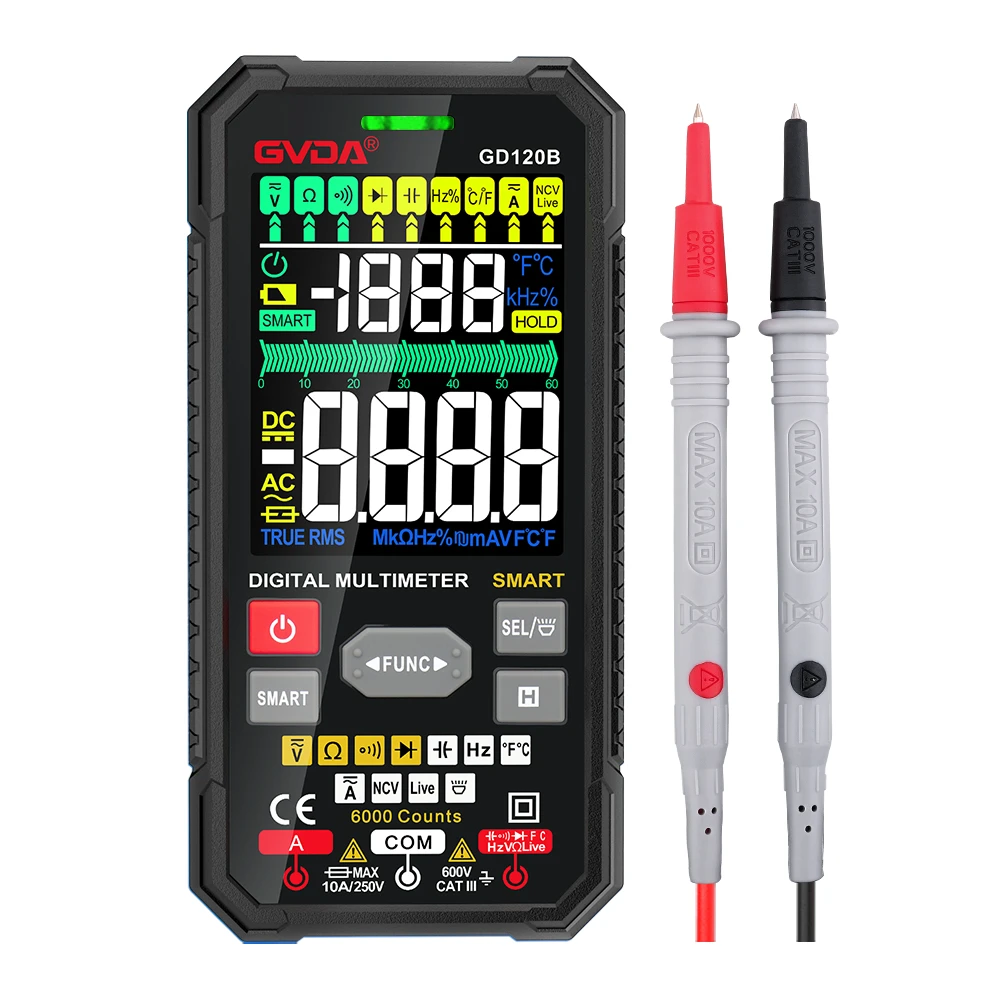
1. Multimeter leakage detection method
Use the on-off gear of the multimeter to measure the ground and the circuit part being measured. If the meter shows a resistance value, it is judged that it is not insulated.
But in fact, if you measure leakage, you should use a megohmmeter, or shake the meter. Because the voltage at both ends of the test leads is very low when the multimeter is measured, generally not more than 9v, and the leakage of the gap cannot be broken down. The megohmmeter can reach more than 1000v. Insert the multimeter connector into the corresponding terminal for measuring AC, then use a pen to measure the zero wire or ground wire, and the other pen to measure the place where you suspect leakage, and see the multimeter indicator. If it is 0, there is no leakage. No voltage! If it is 220 or other voltage indications exceeding 36V, it is leakage, indicating that it is not safe here!
Use a multimeter to measure the insulation resistance at the 200M resistance range, and first determine which wire is leaking, or which two wires are short-circuited.
Methods as below:
Measure the insulation resistance of the live wire and the neutral wire, measure the insulation resistance of the live wire to the ground wire, and measure the insulation resistance of the neutral wire to the ground wire. If the short circuit insulation resistance is basically zero.
Know which line is leaking, and use the segmented search method to gradually narrow down the scope of the fault.
Or use the exclusion method to separate the circuit and then perform a section-by-section energization test.
2. How does the multimeter distinguish between the neutral wire and the live wire
Generally speaking, it is necessary to use a low-voltage test pen to identify the neutral wire and the live wire in the mains. Can a multimeter be used to distinguish between the live wire and the neutral wire?
The answer is yes, the method is as follows:
Turn the range switch of the multimeter to 250V or 500V AC voltage. The black test lead is connected to the indoor plumber's wet ground, soil, etc., and the red test lead is in contact with the power cord or power socket hole. The voltage value indicated by the multimeter is the live wire, and the voltage value is low or zero.
3. The method of measuring the zero line with a digital multimeter
With a multimeter, you can easily measure the neutral wire and live wire at home, as long as you use the AC voltage range of a digital multimeter, a clamp-type multimeter, or a pointer mechanical multimeter. Switch the range of the multimeter to the AC voltage range (should all multimeters have this function, the range is from 200mV to 750V, generally choose the 200V range, and some clamp meters do not have the 200V range, you can choose a larger range.
If the gear of the pointer multimeter is smaller, you can choose 10 V 100 V) and then insert the red and black test pens into V /COM (the jack for measuring the 220V voltage of home appliances), and wrap the black test lead wire in the left hand 2-3 circles (see the picture) ) Of course, the more the better, pay attention: at this time, the metal needle of the black test pen must not touch your hand to prevent electric shock and then you can test it. Use the red test pen in your right hand to measure the socket or the zero live wire respectively, and you will record the results of the two measurements. There must be a large voltage and a small voltage between them. The measured voltage is the live wire, and the small voltage value is of course the neutral wire. If the geodesic wire is definitely no smaller voltage or even no voltage (depending on your home Is the ground wire connected?) The difference between the measured value of the voltage between the neutral wire and the live wire is clear at a glance.