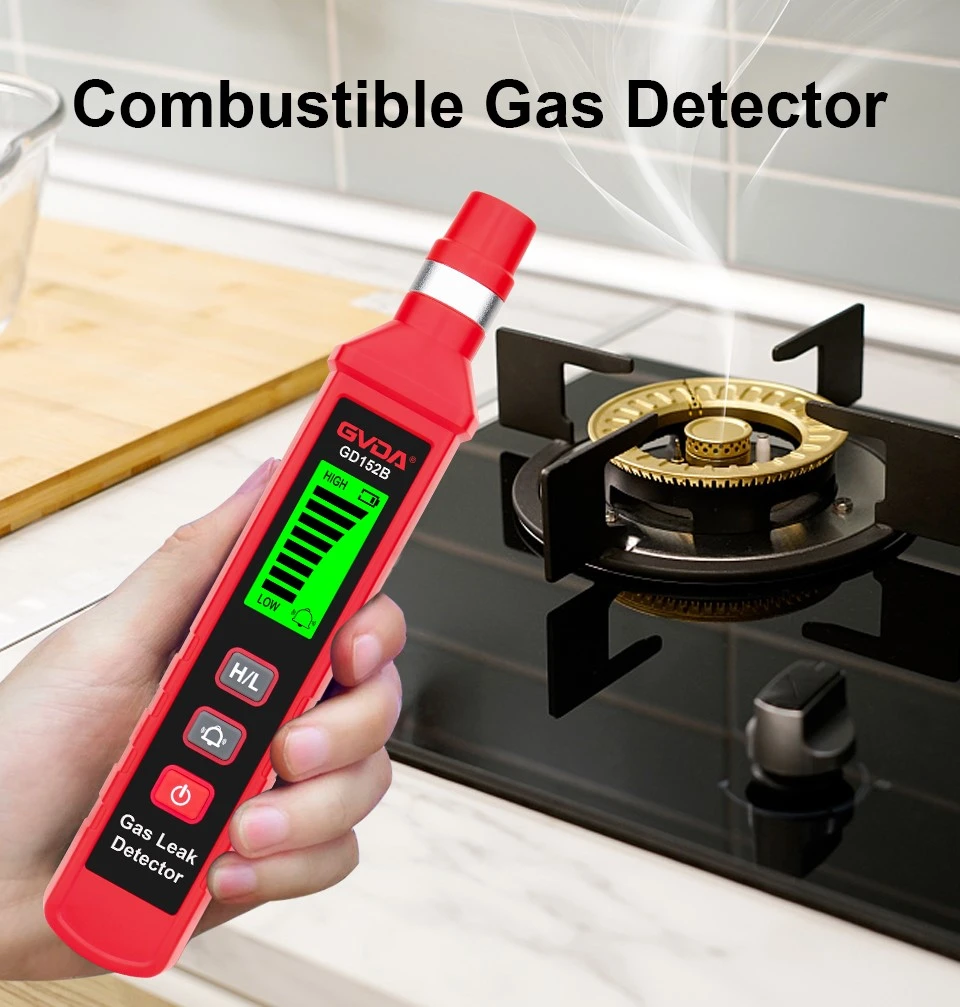
A Brief Introduction to Several Factors Affecting the Use of Gas Detectors
I. Pay Attention to the Detection Interference Among Different Sensors
Generally speaking, each sensor corresponds to a specific gas to be detected, but no gas detector can be completely specific. Therefore, when selecting a gas sensor, it is necessary to understand as much as possible the detection interference of other gases on this sensor, so as to ensure its accurate detection of the specific gas.
II.
Toxic and harmful gas detectors, like other analytical and detection instruments, are all measured by a relative comparison method: First, calibrate the instrument with a zero gas and a gas of a standard concentration to obtain a standard curve and store it in the instrument. During the measurement, the instrument compares the electrical signal generated by the gas concentration to be measured with the electrical signal of the standard concentration, and calculates to obtain an accurate gas concentration value. Therefore, zeroing the instrument at any time and regularly calibrating the instrument are essential tasks to ensure the accurate measurement of the instrument. It should be noted that many gas detectors can currently replace the detection sensor. However, this does not mean that a detector can be equipped with different detector probes at any time. Whenever replacing the probe, in addition to a certain sensor activation time, it is also necessary to recalibrate the instrument. In addition, it is recommended that before using various instruments, perform a response test on the instrument with standard gas to ensure that the instrument can truly play a protective role.
III. Pay Attention to the Service Life of Various Sensors
All kinds of gas sensors have a certain service life, that is, lifespan. Generally speaking, in portable instruments, the LEL sensor has a relatively long lifespan, usually about three years; the lifespan of the photoionization detector is four years or longer; the lifespan of the electrochemical specific gas sensor is relatively shorter, generally between one and two years; the lifespan of the oxygen sensor is the shortest, probably about one year. The lifespan of the electrochemical sensor depends on the dryness of the electrolyte in it. Therefore, if it is not used for a long time, sealing it and placing it in an environment with a lower temperature can extend its service life to a certain extent. Therefore, it is necessary to detect the sensor at any time, use it as much as possible within the valid period of the sensor, and replace it in a timely manner once it fails.
IV. Pay Attention to the Concentration Measurement Range of the Detection Instrument
All kinds of toxic and harmful gas detectors have their fixed detection ranges. Only when the measurement is completed within its measurement range can the accurate measurement of the instrument be ensured. And measuring beyond the measurement range for a long time may cause irreversible damage to the sensor. For example, if the LEL detector is accidentally used in an environment exceeding 100% LEL, it may completely burn out the sensor. For toxic gas detectors, long-term use at a higher concentration will also cause damage. Therefore, when a fixed instrument emits an over-limit signal during use, the measurement circuit should be immediately turned off to ensure the safety of the sensor.