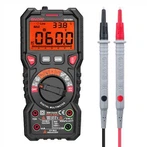
A case study of using a clamp ammeter to measure the no-load current of three-phase asynchronous motors
The secondary winding of the through core current transformer of the clamp ammeter is wound around the iron core and connected to the AC ammeter. Its primary winding is the measured wire passing through the center of the transformer. The knob is actually a range selection switch, and the function of the wrench is to open and close the movable part of the core of the through core transformer, so as to clamp it onto the measured wire.
When measuring the current, press the wrench, open the pliers, and place the measured current carrying wire in the middle of the through type current transformer. When there is alternating current passing through the measured wire, the magnetic flux of the alternating current induces a current in the secondary winding of the transformer. This current passes through the coil of the electromagnetic ammeter, causing the pointer to deflect and indicating the measured current value on the dial scale.
After inserting the tested wire into the window through the iron core button, it is important to ensure that the two sides of the clamp have a good fit and that no other objects are placed in the middle;
The minimum range of a clamp meter is 5A, and the display error will be larger when measuring small currents. This can be measured by winding the energized wire on a clamp meter for a few turns, and the obtained reading value is divided by the number of turns to obtain the desired result.
A case study of using a clamp ammeter to measure the no-load current of three-phase asynchronous motors
Example 1
A ore crusher with a driving motor of 15kW. After the major overhaul of the motor, it operates normally without load, but cannot carry load. When a load is added, the motor will overload and trip. After inspection, the mechanical and power supply are all normal. The DC resistance of the motor coil is measured to be 2.4 Ω, 3.2 Ω, and 2.4 Ω, respectively; Using a clamp ammeter to measure the three-phase no-load currents of 9A, 5A, and 8.8A respectively, it can be confirmed that there is a fault in the motor coil. After removing the motor end cover, it was found that one of the wire ends of one phase winding had been loosened, and the solder had melted. The motor is wound in parallel with two wires, one of which is disconnected while the other is still connected, resulting in a decrease in torque. It can only rotate without load, but cannot carry the load.
Example 2
There is a motor with a rated power of 13kW, and the coil is rewound for testing. When the motor runs at no load, its speed is normal. However, when the load is applied, the motor speed is very slow and even does not rotate. The measured power supply voltage and resistance of each phase are normal. The three-phase no-load current is basically balanced when measured with a clamp meter, but the current values are relatively small. Therefore, it is concluded that the winding connection is incorrect. Opening the end cover, it was found that the motor, which was originally connected by △, was mistakenly connected to Y connection, causing the normal operating torque to be too small and unable to carry the load, because the torque of Y connection is one-third of that of △ connection.
Example 3
A certain machine tool uses a 4kW motor. After connecting to the power, the motor does not rotate and only makes a buzzing sound. Remove the motor wire, measure that there is electricity on the power side, the three-phase voltage is normal, the DC resistance of the winding is balanced, the insulation is qualified, and the mechanical rotation is flexible. Afterwards, a clamp ammeter was used to measure the no-load current on the motor lead under the switch, and the results showed that there was current in both phases and no current in one phase. There is a fault in the wire inside the conduit. Pulling out the wire inside the steel pipe, it was found that a section of the wire had basically broken, facing like two needle tips, and there was white oxide powder at the end of the wire. This is due to the excessive pulling force when threading the pipe, causing the wire to be stretched and stretched, and the prolonged electrification current to generate heat and oxidize at the seemingly unbroken point. At this point, voltage can still be measured on the wire head, but current cannot be passed through.