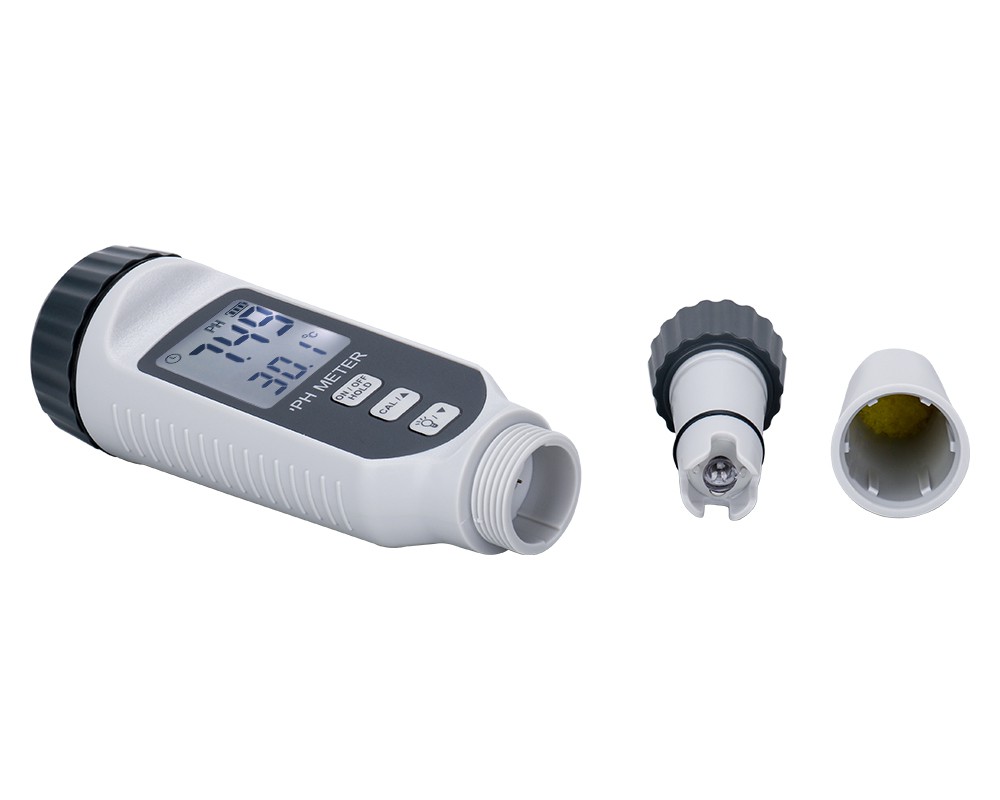
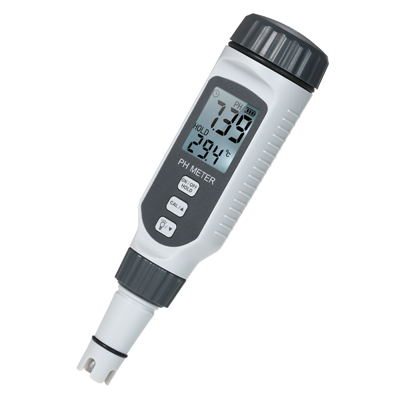
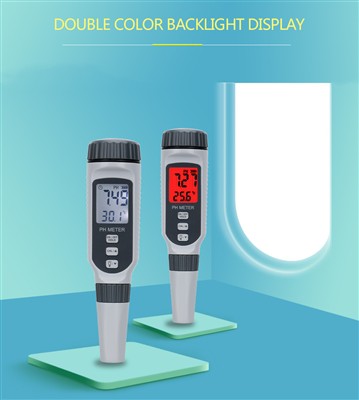
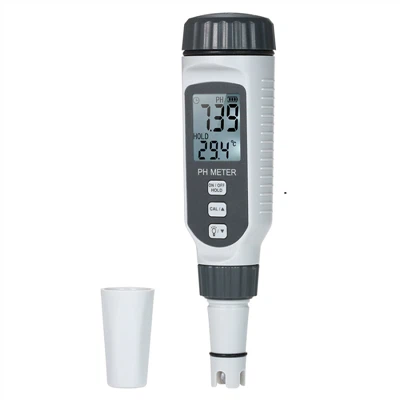
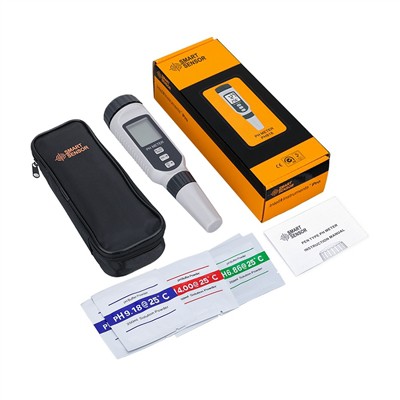
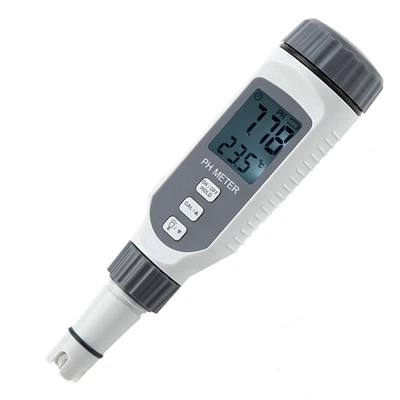
A list of the causes of the PH meter's digital instability
1. Check whether the electrode is damaged;
2. It should be that the electrode has been used for too long, first calibrate to see if it is effective;
3. You can try soaking the probe with 2.5MMOL/L KCL solution;
4. Clean the glass ball, is it a long time, some organic matter is attached to it, resulting in insensitive reaction;
5. There is a chemical equilibrium in water~CO2+H2O→H++HCO3-, because the general pure water or surface water is weakly alkaline, so the balance will move to the positive reaction direction, so the pH will always rise~I personally think it is Such;
6. Add a neutral salt (such as Kcl) as an ionic strength regulator to the water sample to be tested to change the total ionic strength in the solution, increase the conductivity, and make the measurement fast and stable. This method stipulates in the national standard GB/T6P04.3-93: "In order to reduce the influence of liquid junction potential and quickly achieve stability when measuring water samples, add a drop of neutral 0.1moL/LKCL solution to every 50ml water sample." Although this method Changing the ionic strength in the water sample caused its pH value to change to a certain extent, but experiments have proved that this change only changes about 0.01pH in value, which is completely acceptable. However, when using this method, it must be noted that the added Kcl solution should not contain any alkaline or acidic impurities. Therefore, the Kcl reagent should be of high purity, and the water quality of the solution should also be high-purity neutral water quality;
7. During the measurement, CO2 is absorbed, and the pH keeps rising;
8. pH measurement pH value, the principle is that an electrode composed of an indicating electrode and a reference electrode is inserted into the solution to form a primary battery. At room temperature (25°C), each unit of pH value is equivalent to an electromotive force change value of 59.1mv. The instrument is directly expressed as a pH reading, and the temperature difference is provided with a compensation device on the instrument. Because pure water has very few ions and cannot form a stable primary battery, a neutral salt (such as KCl) is added to the water sample to be tested as an ionic strength regulator to change the total ionic strength in the solution, increase the conductivity, and make the measurement fast and stable;
9. The reading of the ph meter is unstable: the measured solution is acidic, and the slope is corrected with a buffer solution of pH=4, and the measured solution is alkaline, and the slope is corrected with a buffer solution of pH=9. The closer the pH value of the solution for slope adjustment is to the pH value of the measured solution, the better;
10. There may be poor contact;
11. If the pH meter shakes slightly, the reading will change;
12. It should not be the reason for the electrode. I think your electrode is dry. You can see for yourself. Generally, there is a small hole on the electrode. Put some 3mol/LKCL in it and it should be done;
13. The unstable pH value of the electrode during use basically has nothing to do with the calibration. It is related to the fluctuation of the power supply voltage, the performance of the electrode, the lead wire of the electrode, the contact of the electrode jack, and the temperature of the solution to be measured. When calibrating, if the measured solution is close to acidic, use "6" for positioning, and if it is alkaline, use "9" for positioning. Both cannot be chosen arbitrarily;
14. It should be a problem with the electrode, activate it before use. Moreover, no matter whether the electrodes are used or not, they will be eliminated within one year. For acidic solutions, use buffers close to 4 and 7 for correction; for alkaline solutions, use buffers 7 and 10 for correction;
15. It is strange that the pH of pure water can only be measured by a pH meter. First of all, it is necessary to understand the measurement principle of the pH meter: the ions contained in the water move directionally under the action of the electrode to form a current to display the reading. Pure water Too few ions, low electrolysis rate, how can the measurement be stable;
16. It may be poor contact. Or the electrode soaking solution (3MOL/L KCL solution) is less, and the electrode is not completely immersed in the electrode soaking solution. In addition, the electrode is aging, or it should be replaced;
17. I think it has something to do with the room temperature. When the temperature is low or the air flow is fast, it will affect the pH meter. The room temperature should be kept stable, and the door and window should be closed when measuring;
18. If you measure pure water, it is normal to be unstable. Originally, it contains few ions and has weak buffering capacity. The environment has a great influence on it. Generally, a relatively stable value is enough.