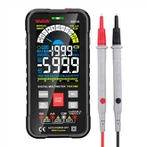
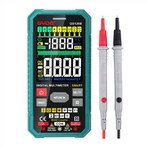
A Simple Principle for Selecting and Purchasing Multimeters and Technical Exchange
The selection of a multimeter generally needs to follow a relatively simple principle: the performance parameters meet the requirements and can meet the requirements of the usage environment.
(1) Select the display digits and resolution of the multimeter based on the actual usage environment and range
The display bit count and resolution are the main performance parameters that should be considered when purchasing a multimeter, and they are also important indicators. Generally speaking, the higher the number of digits displayed on a multimeter, the higher the accuracy. For situations that require high measurement accuracy, a multimeter with high display bit count and resolution should be selected, and the price of such a multimeter is relatively high; If it is only used for general measurement purposes, such as repairing electrical equipment such as televisions and induction cookers, the usual position is 3 1/2.
(2) Select the amplitude value and frequency response performance of the AC signal according to the needs of the measurement project
Generally speaking, the inspection methods for resistance, DC voltage, DC current, and other items are generally the same for various multimeters. However, for AC signal measurement, there are many complex situations with AC signals. With the change of AC signal frequency, there are items such as frequency response and amplitude conversion methods.
Usually, AC signal measurement methods can be divided into mean value multimeter measurement and true RMS multimeter measurement based on multimeters.
① The average multimeter measurement is generally used for pure sine waves, and it uses the method of estimating the average to measure AC signals. There will be significant errors in non sinusoidal signals, and if there is harmonic interference in sinusoidal signals, the measurement error will also change significantly.
② True RMS multimeter measurement uses the instantaneous peak value of the waveform multiplied by 0.707 to calculate current and voltage, ensuring accurate readings in distorted and noisy systems.
Based on the above differences, users should choose different measurement methods and AC frequency response multimeters according to the type and required accuracy of the actual measurement object.
(3) Select the functions and measurement range of the multimeter as needed
According to the types of multimeters mentioned above, different types and grades of multimeters have different functions and measuring ranges. For ordinary users, if it only involves measuring current, voltage, resistance, and on-off, a regular multimeter can be used; For the field of electronic measurement, it is often necessary to measure the corona of diodes, transistors, etc., so it is necessary to choose a multimeter with measurement functions such as diodes, transistors, frequency, temperature, etc.
I believe that based on the above principle, you will not be so confused when choosing a multimeter. I hope the above can provide you with some help.