Advantages and disadvantages of a half bridge transformer switch mode power supply
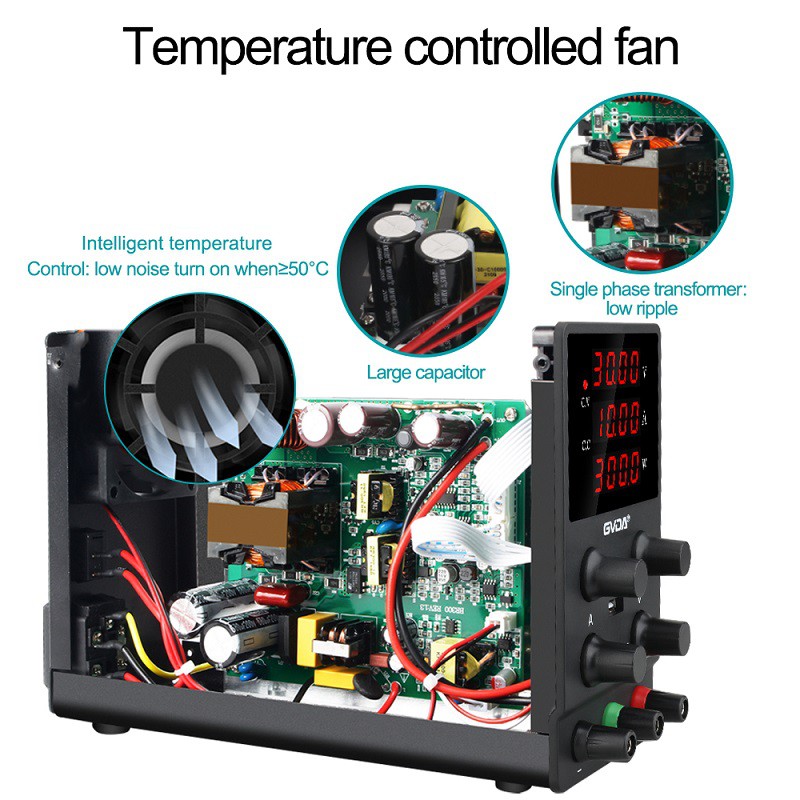
The half bridge transformer switching power supply is similar to the push-pull transformer switching power supply. Due to the alternating operation of the two switching tubes, it is equivalent to two switching power supplies outputting power simultaneously, and its output power is about twice the output power of a single switching power supply. Therefore, the half bridge transformer switching power supply has a high output power and work efficiency. After bridge rectification or full wave rectification, the voltage ripple coefficient Sv and current ripple coefficient Si of the output voltage are very small. Only a small filtering inductance and capacitor are needed, and the output voltage ripple and current ripple can be very small.
The biggest advantage of a half bridge transformer switching power supply is that the voltage resistance requirement for two switching devices can be reduced by half compared to a push-pull transformer switching power supply. Because the working voltage of the two switching devices in the half bridge transformer switching power supply is only half of the input power supply Ui, its maximum withstand voltage is equal to the sum of the working voltage and the back electromotive force, which is about twice the power supply voltage. This result is exactly half of the withstand voltage of the two switching devices in the push-pull transformer switching power supply. Therefore, half bridge transformer switching power supplies are mainly used in situations where the input voltage is relatively high. Most high-power switching power supplies with a general grid voltage of AC 220V are powered by half bridge transformer switching power supplies.
The transformer primary coil of a half bridge switching power supply only requires one winding, which is also its advantage. This brings some convenience to the winding of the coil of a low-power switching power supply transformer. However, there is no advantage in winding the coils of high-power switching power transformers, as the coils of high-power switching power transformers require multiple strands of wire to be wound.
The main drawback of a half bridge transformer switching power supply is its low power utilization rate. Therefore, a half bridge transformer switching power supply is not suitable for applications with low operating voltage. In addition, the connection between the two switching devices in the half bridge transformer switching power supply does not have a common ground, making it difficult to connect with the driving signal.
The biggest drawback of a half bridge switching power supply is that when two control switches K1 and K2 are in an alternating switching state, both switching devices will simultaneously have a short period of semi conducting area, that is, both control switches are in the on state at the same time. This is because when the switching device starts to conduct, it is equivalent to charging the capacitor, and it requires a transition process from the cut-off state to the fully conducting state; When the switching device transitions from the on state to the off state, it is equivalent to discharging the capacitor, and it also requires a transition process from the on state to the fully off state.