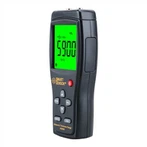
Analyzing the purchaser of gas detector and the service life of the sensor
Gas detector is an instrumentation tool for gas leakage concentration detection, including: portable gas detector, hand-held gas detector, fixed gas detector, online gas detector, etc. Gas sensors are mainly used to detect the types of gases existing in the environment. Gas sensors are sensors used to detect the composition and content of gases.
It is generally believed that the definition of gas sensors is based on the classification of detection targets, that is to say, any sensor used to detect gas composition and concentration is called a gas sensor, regardless of whether it uses physical methods or chemical methods. For example, sensors that detect gas flow are not considered gas sensors, but thermal conductivity gas analyzers are important gas sensors, although they sometimes use roughly the same detection principle.
Classification
Semiconductor
It is manufactured by using some metal oxide semiconductor materials, and at a certain temperature, the electrical conductivity changes with the change of the ambient gas composition. For example, the alcohol sensor is prepared by using the principle that the resistance of tin dioxide will decrease sharply when it encounters alcohol gas at high temperature.
advantage
Semiconductor gas sensors can be effectively used for the detection of many gases such as methane, ethane, propane, butane, alcohol, formaldehyde, carbon monoxide, carbon dioxide, ethylene, acetylene, vinyl chloride, styrene, acrylic acid, etc. In particular, the sensor has low cost and is suitable for the needs of civilian gas detection. The following semiconductor gas sensors are successful: methane (natural gas, biogas), alcohol, carbon monoxide (city gas), hydrogen sulfide, ammonia (including amines, hydrazines). High-quality sensors can meet the needs of industrial detection.
shortcoming
The stability is poor, and it is greatly affected by the environment; especially, the selectivity of each sensor is not unique, and the output parameters cannot be determined. Therefore, it is not suitable for use in places where accurate measurement is required.
Combustion
This sensor prepares a high temperature resistant catalyst layer on the surface of the platinum resistor. At a certain temperature, the combustible gas is catalyzed and burned on its surface. The combustion is the temperature rise of the platinum resistor, and the resistance changes. The change value is the concentration of the combustible gas. function.
advantage
Catalytic combustion gas sensors selectively detect combustible gases: the sensor does not respond to anything that is not combustible. The catalytic combustion gas sensor has accurate measurement, fast response and long service life. The output of the sensor is directly related to the explosion hazard of the environment, and it is a dominant type of sensor in the field of safety detection.
shortcoming
In the range of flammable gases, there is no selectivity. There is a danger of ignition and explosion when working with dark fire. Most elemental organic vapors are toxic to sensors.
thermal conductivity pool
Each gas has its own specific thermal conductivity. When the thermal conductivity of two or more gases is quite different, the thermal conductivity element can be used to distinguish the content of one of the components. This sensor has been used sensorily for the detection of hydrogen, the detection of carbon dioxide, and the detection of high-concentration methane.