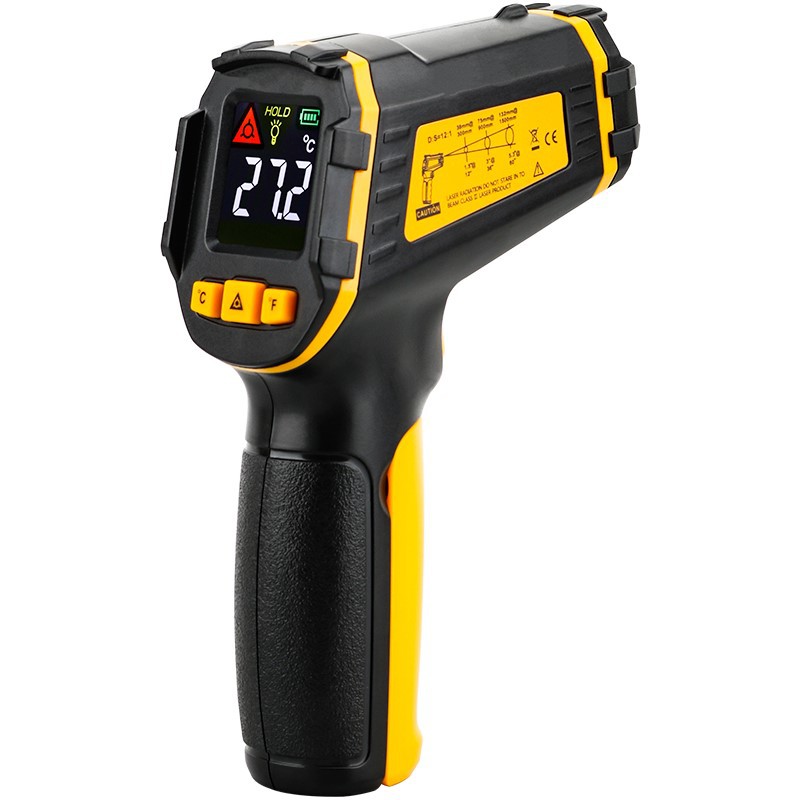
Application of Infrared Thermometers in Steel Rolling Production
Taking the temperature measurement during controlled rolling and controlled cooling on the roughing mill at the Medium and Heavy Plate Plant of Jinan Iron and Steel as an example, four sets of LAND infrared thermometers are installed respectively before and after the water curtain cooling devices downstream of the descaling box, upstream of the roughing mill and downstream of the roughing mill. The descaling box creates conditions for measuring the temperature of scale-free steel plates. Before the slab enters the mill, almost all iron oxide scale and other contaminants are washed away by high-pressure water spray, providing a clean surface for the rolling process. The probes start to measure the actual surface temperature of the steel plate to ensure the temperature is within the rolling limit and formulate rolling parameters accordingly.
The main challenges encountered are as follows:
To determine a reasonable installation position for non-contact probes to minimize the adverse effects of spray and oxides from the descaling box.
To maintain a safe distance between the probes and the mill housing, so as to prevent probe damage caused by splashed oxides during rolling.
Water and residual scale on the slab surface may form low-temperature zones, resulting in fluctuating temperature readings.
The fundamental principle of radiation temperature measurement is that the thermometer only detects the target within its field of view. Two solutions are available to eliminate gas absorption of thermal radiation: one is to adopt sighting tubes and air purging devices to ensure an unobstructed optical path; the other is to select an operating wavelength band immune to interference from surrounding media.To address the above problems, the M1/R1 short-wavelength probes from the high-reliability LAND SYSTEM series are adopted. This model effectively avoids temperature measurement errors caused by water vapor absorption. With small target spotting and fast response characteristics, the probe can aim at the high-temperature area between iron oxide scale and residual water on the slab surface. Equipped with a peak hold function in the signal processor, it guarantees high accuracy and continuity of temperature detection. Even if the measured target is partially shielded or temporarily out of the field of view, qualified temperature data can still be obtained, enabling the system output to accurately track the actual temperature of the steel plate.The high-level signal output of the probe weakens the impact of electromagnetic interference and can be directly used for final temperature display. Meanwhile, probes are arranged as close to the mill entry as possible to avoid interference from cooling water spray and equipment movement.