Application of pH Meters in Wastewater Treatment
The acidity or alkalinity of any solution can be expressed in terms of hydrogen ion concentration. Due to the ionization effect of water itself, at 22 ℃, each liter of pure water contains 10-7 grams of [H+], while the atomic weight and valence of hydrogen are both 1. Therefore, each liter of pure water contains 10-7 grams of equivalent [H+]. Since [H+] in pure water is generated by the dissociation of water molecules themselves, that is:
H2O=H++OH-
Pure water is neutral, meaning that the concentrations of two ions are equal, [H+]=[OH-], Its product is a constant at constant temperature, called ion product K water.
K water=[H+] [OH -]=10-7 * 10-7=10-14
The above formula is applicable to any acidic or alkaline solution, that is, any aqueous solution, where the product of [H+] [OH -] is equal to 10-14. For example, in a certain aqueous solution, if [H+]=10-3, then [OH -] must be 10-11. Therefore, for any aqueous solution, as long as [H+] is known, [OH -] can be easily obtained. pH is usually defined by the negative logarithm of the common logarithm of hydrogen ion concentration, expressed as: pH=- lg [H+],
Therefore, the pH value of neutral solution is equal to 7. If there is an excess of hydrogen ions, the pH value is less than 7 and the solution is acidic; On the contrary, if there is an excess of hydroxide ions, the solution becomes alkaline.
The pH value depends on the amount of dissolved substances, so pH can sensitively indicate changes in water quality. The change in pH value has a significant impact on the reproduction and survival of organisms, and also seriously affects the biochemical process of activated sludge, which affects the treatment effect. The pH value of sewage is generally controlled between 6.5 and 7.
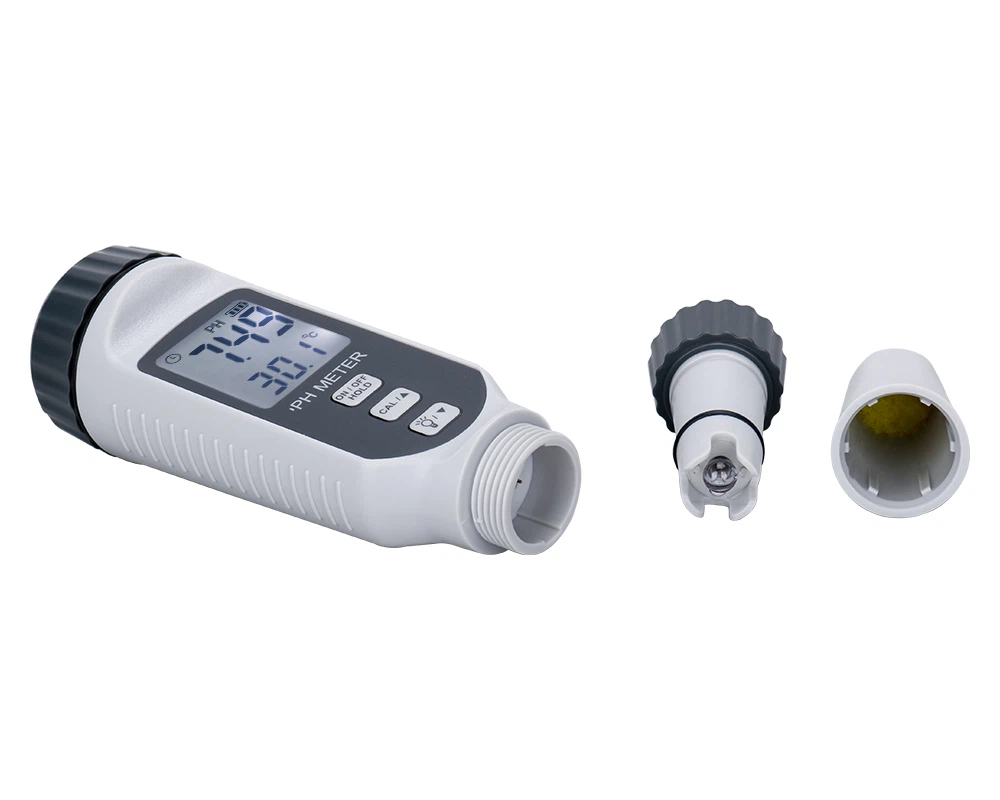
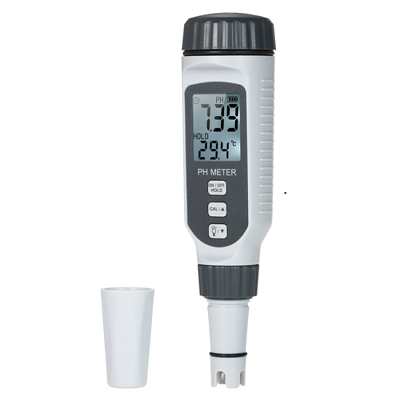
The pH value is usually measured by potentiometry, using a constant potential reference electrode and a measuring electrode to form a primary cell. The magnitude of the primary cell's electromotive force depends on the concentration of hydrogen ions and also on the acidity or alkalinity of the solution. Type submerged pH meter. The measuring electrode of this instrument adopts a special glass electrode that is sensitive to pH, which has the characteristics of high measurement accuracy and good anti-interference. When it is immersed in the test solution, the hydrogen ions in the test solution are in equilibrium with the hydrogen ions in the hydration layer on the surface of the electrode bulb. At the same time, a potential difference is generated between the solution inside and outside the glass bulb and the hydration layer on the inner wall of the electrode bulb. The glass electrode is filled with a buffer solution with a fixed pH value, and the electrode immersed in the solution forms a half cell. The half cell formed by immersing the calomel electrode in a saturated potassium chloride solution is simultaneously introduced into the converter for measurement. The pH value is different, and the corresponding potential is also different. It is converted into a standard 4-20mA output through a transmitter.