Basic Definition and Applied Range of Anemometers
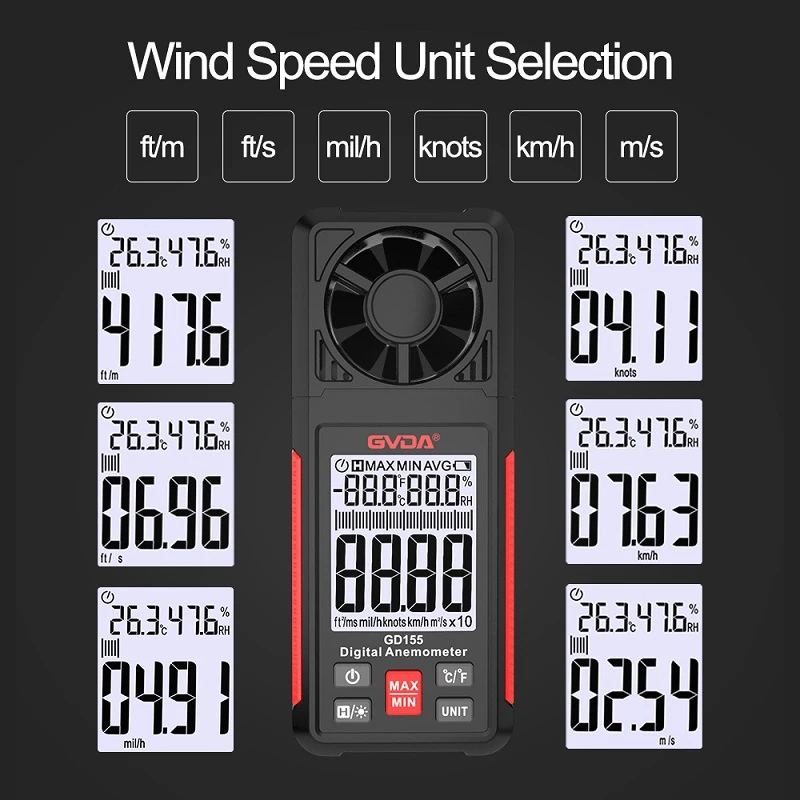
An anemometer, as the name suggests, is an instrument used to measure air flow velocity. There are many types of anemometers. The cup anemometer is most commonly used at meteorological stations. Its sensing unit consists of three parabolic conical cups fixed to a bracket at intervals of 120 degrees, with the concave sides of the cups facing the same direction. The entire sensing assembly is mounted on a vertical rotating shaft. Driven by wind force, the cups rotate around the shaft at a speed proportional to wind velocity. Another rotary type is the propeller anemometer, whose sensing part is a three‑bladed or four‑bladed propeller installed at the front of a wind vane to face the incoming wind at all times. The blades rotate around a horizontal axis at a rotational speed proportional to wind speed.
Anemometers are specialized devices for measuring wind velocity. Wind speed is often overlooked in daily life due to the misconception that it has little relevance to ordinary activities. In fact, wind conditions are closely linked to numerous industries, where anemometers play an essential role. Typical examples are listed below.
During the construction of table tennis and badminton venues for the 2008 Beijing Olympic Games, anemometers were adopted for on‑site testing. Since cooling systems were installed inside the venues, the original design planned large ventilation outlets for air supply. However, measurements taken by anemometers proved that indoor airflow would interfere with ball movement during competitions. Excessive airflow would cause deviation in the flight path of table tennis balls and badminton shuttlecocks. To resolve this issue, designers replaced large air vents with small individual air outlets installed above each seat, ensuring effective cooling while stabilizing indoor airflow. Although this solution increased construction costs, airflow data verified by anemometers fully met the indoor air circulation standards specified by the International Olympic Committee.
Anemometers were also widely applied in other Olympic events, including sailing, rowing and field shooting competitions. Modern anemometers are highly integrated; besides wind speed, they can simultaneously measure wind temperature and air volume. A wide range of industries rely on anemometers for daily operations, even though this fact is not widely recognized. Equipped with such instruments, operational efficiency and overall work quality can be effectively improved.