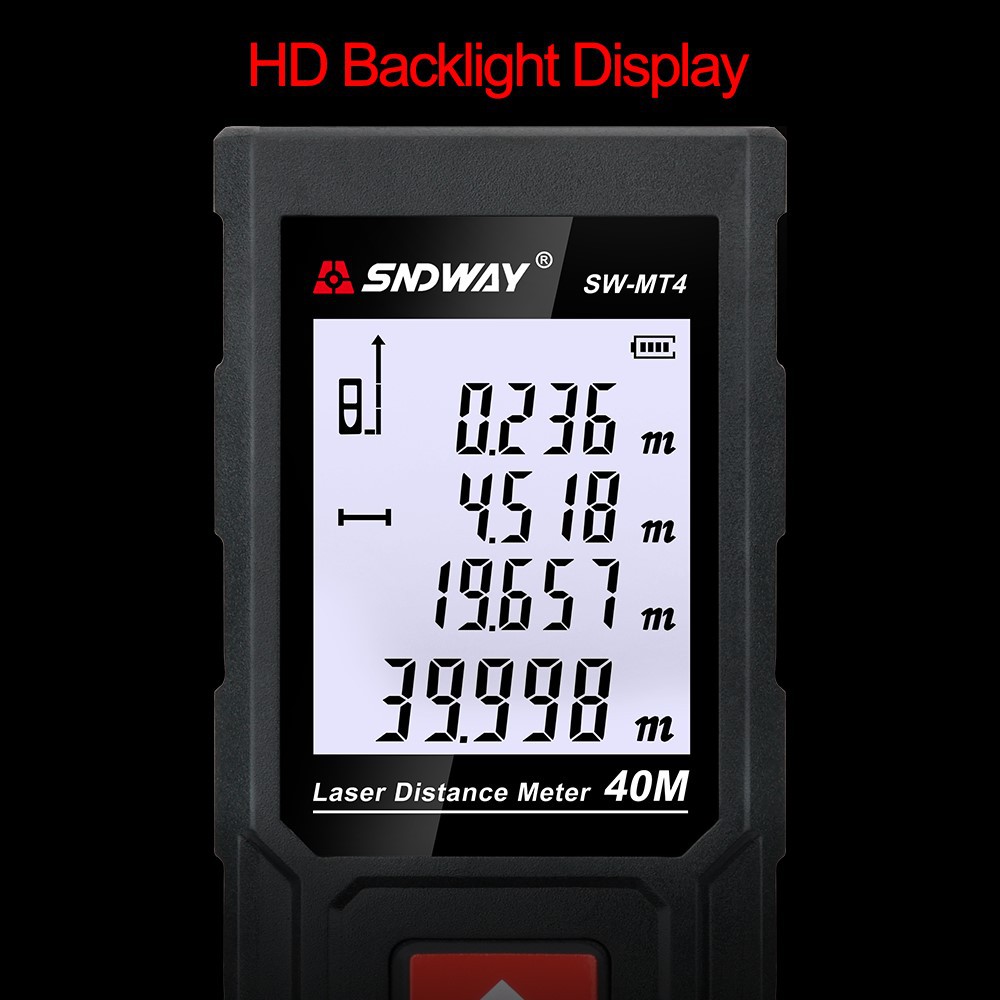
Brief Discussion on the Principle and Usage of Laser Rangefinders
1. The principle of using infrared or laser ranging
The principle of distance measurement can be basically summarized as measuring the time required for light to travel back and forth to the target, and then calculating the distance D through the speed of light c=299792458m/s and the atmospheric refractive index n. Due to the difficulty of directly measuring time, it is usually necessary to determine the phase of continuous waves, which is called a phase measuring rangefinder. Of course, there are also pulse rangefinders, with the typical being WILD's DI-3000.
It should be noted that phase measurement does not measure the phase of infrared or laser, but rather the phase of the signal modulated on the infrared or laser. There is a handheld laser rangefinder in the construction industry used for measuring houses, and its working principle is the same as this.
2. The plane of the object being measured must be perpendicular to the light rays
Usually, precision distance measurement requires the use of a total reflection prism, while the distance measuring instrument used for house measurement directly measures the reflection of smooth walls, mainly because the distance is relatively close and the signal strength reflected back by the light is strong enough. It can be inferred that it must be perpendicular, otherwise the return signal will be too weak to obtain accurate distance.
3. It can measure whether the object plane is diffuse reflection
It is usually possible, but in practical engineering, thin plastic sheets are used as reflective surfaces to solve the problem of severe diffuse reflection.
4. Ultrasonic ranging accuracy is relatively low and is rarely used.
5. The accuracy of laser rangefinder can reach 1 millimeter error, suitable for various high-precision measurement purposes.
purpose
Laser rangefinders are widely used for terrain measurement, battlefield measurement, ranging of targets by tanks, aircraft, ships, and artillery, measuring the altitude of clouds, aircraft, missiles, and artificial satellites. It is an important technical equipment for improving the accuracy of high tanks, aircraft, ships, and artillery. Due to the continuous price reduction of laser rangefinders, they are gradually being used in industry and can be widely applied in industrial measurement and control, mining, ports and other fields.
application
The application of handheld laser rangefinders in house measurement has always been a concern and concern for the housing management department. The house survey area map is directly used as an attachment to the property ownership certificate and has legal effect. It is not only directly facing the people, but also directly related to the economic interests of the people, so the control of measurement errors in housing is particularly important. According to past habits, using tape measures or steel tapes to measure building area and usage area can also meet basic requirements. However, there are significant errors in long-distance measurement, floor height measurement, and difficult to reach measurement, as well as disadvantages such as high labor intensity and complex work. In today's rapidly developing high-tech society, such primitive and traditional measurement methods are clearly not in line with the requirements of today's information society for rapid and efficient measurement. Therefore, after introducing a handheld laser rangefinder and several months of practical use, it is generally believed that this instrument is particularly suitable for measuring complex building structures, mid to high rise buildings, and long-distance buildings. Easy to use, precise measurement data (3mm accuracy), improved work efficiency (non-contact measurement possible), completely abandoning the method of measuring houses with a tape measure (or steel tape measure), reducing surveying errors, ensuring area measurement accuracy, and making the measurement results more convincing to the owners. Of course, there are also aspects of the instrument that urgently need improvement, such as difficulty in seeing long-distance target objects under strong sunlight, which requires the use of telescopes and other accessories. In addition, calibrating the level bubbles during each measurement is laborious, so it is best to have automatic calibration. In short, handheld laser rangefinders are still popular among us