Brief explanation of how to operate the anemometer
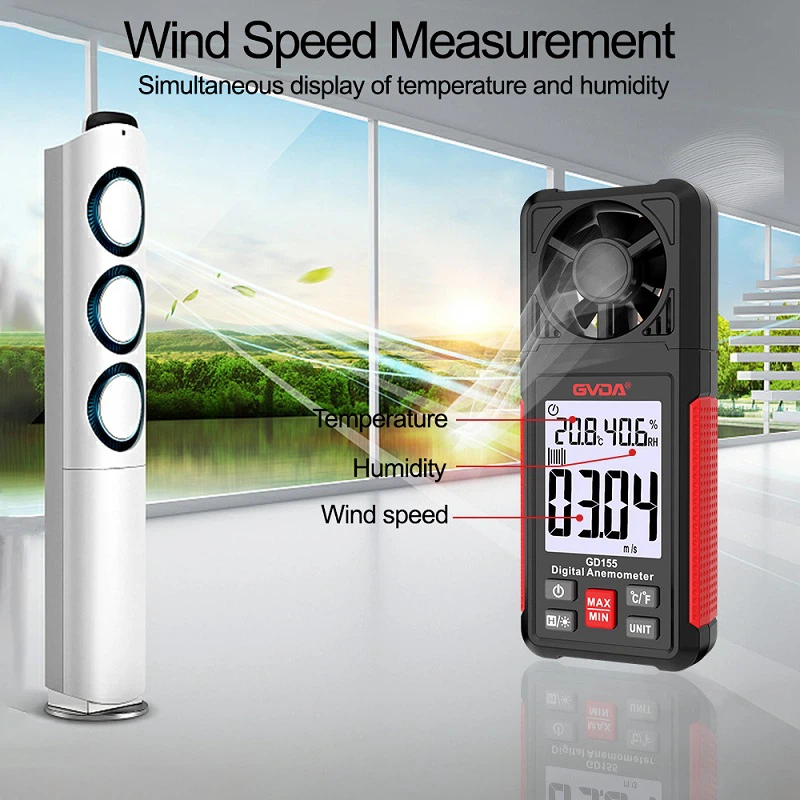
An anemometer is an instrument used to measure the velocity of air flow. There are many types of it, and the commonly used one in meteorological stations is the wind cup anemometer. It consists of three parabolic cone empty cups fixed at 120 ° to each other on a bracket to form the sensing part, and the concave surfaces of the empty cups all face in the same direction. The entire sensing part is installed on a vertical rotating axis, and under the action of wind, the wind cup rotates around the axis at a speed proportional to the wind speed.
Operation steps of anemometer:
1. Before use, observe whether the pointer of the electric meter points to zero. If there is any deviation, gently adjust the mechanical adjustment screw of the electric meter to make the pointer return to zero;
2. Place the calibration switch in the off position;
3. Insert the measuring rod plug into the socket, place the measuring rod vertically upwards, tighten the screw plug to seal the probe, place the "calibration switch" in the full position, slowly adjust the "full adjustment" knob to make the meter pointer point to the full position;
4. Place the "calibration switch" in the "zero position" and slowly adjust the "coarse adjustment" and "fine adjustment" knobs to make the meter pointer point to the zero position;
5. After the above steps, gently pull the screw plug to expose the measuring rod probe (the length can be selected according to needs), and make the red dot on the probe face the wind direction. Based on the reading of the electric meter, refer to the calibration curve to find out the measured wind speed;
After measuring for several minutes (about 10 minutes), steps 3 and 4 above must be repeated once to standardize the current inside the instrument;
After the test is completed, the "calibration switch" should be placed in the off position.
Anemometers can be widely used in various fields, such as power, steel, petrochemicals, energy conservation, etc. In daily life, many industries require anemometers, such as fan manufacturing, offshore fishing, exhaust heating systems, etc., to measure wind speed, temperature, and volume to ensure normal operation.