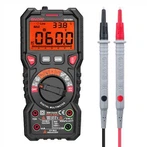
Can a multimeter test the quality of a lithium battery?
How to use a multimeter to judge whether a rechargeable battery is good or bad. The following is an example of a lithium-ion battery with a standard voltage of 4.2V. It means that the battery is not bad, if the voltage is higher than 4.2V after fully charged, it means that there is something wrong with the charger (note that the voltmeter must be accurate). Please see the introduction below.
1. The nominal voltage of the lithium-ion battery is 3.7V (3.6V), and the charging cut-off voltage is 4.2V (4.1V, which has different designs according to the brand of the battery cell). (The specification of lithium-ion batteries is: lithium-ion secondary batteries)
2. Requirements for charging lithium-ion batteries (GB/T182872000 specification): First, constant current charging, that is, a constant current, while the battery voltage gradually increases with the charging process. When the battery terminal voltage reaches 4.2V (4.1V), change to constant current Charging is constant voltage charging, that is, the voltage is constant, and the current gradually decreases as the charging process continues according to the saturation degree of the battery cell. When it decreases to 0.01C, the charging is considered to be terminated. (C is a way of expressing the nominal capacity of the battery compared to the current. For example, if the battery has a capacity of 1000mAh, 1C is the charging current of 1000mA. Note that it is mA instead of mAh. 0.01C is 10mA.) Of course, the standard expression is 0.01 C5A, I simplified here.
3. Why do you think that 0.01C is the end of charging: this is stipulated in the national standard GB/T18287-2000, and it is also discussed. In the past, everyone generally ended with 20mA, and the industry standard YD/T998-1999 of the Ministry of Posts and Telecommunications also stipulated this, that is, no matter how large the battery capacity is, the stop current is 20mA. The 0.01C stipulated by the national standard helps to charge more fully, which is beneficial for the manufacturer to pass the appraisal. In addition, the national standard stipulates that the charging time should not exceed 8 hours, that is to say, even if it has not reached 0.01C, the charging is considered to be over after 8 hours. (Batteries with good quality should reach 0.01C within 8 hours. For batteries with poor quality, it is meaningless to wait)
4. Since there is a protection board in the battery, can we rest assured? No, because the cut-off parameter of the protection board is 4.35V (this is still good, the worst is 4.4 to 4.5V), and the protection board is just in case , if it is overcharged every time, the battery will decay quickly.
5. How much charging current is appropriate: in theory, the smaller it is, the better it is for the battery. But you can't wait 3 days to charge a battery. The low-rate charging specified by the national standard is 0.2C (arbitration charging system). Taking the above 1000mAh capacity battery as an example, it is 200mA, then we can estimate that this battery can be fully charged in more than 5 hours. (Capacity mAh = current mA & TImes; time h) The national technical supervision department appraises the lithium battery capacity, which is charged at a high rate of 1C, discharged at a low rate of 0.2C, and the capacity value is calculated by time. The number of tests is 5 times, and there is 1 capacity reached the end of the test. (That is, there are 5 chances. If the first test is qualified, the next 4 times will not be done.) A pre-cycle is allowed before the test, that is, it will stop when it is charged to 4.2V with a constant current of 1C, and there is no subsequent constant voltage. 0.01C process, let alone 14 hours.
6. How much charging current can the lithium-ion battery withstand: the manufacturer can test it very high, but the high rate of the national standard is 1C. Taking the above battery as an example, it can be fully charged in more than 1 hour. Can the battery withstand such a large charging current? For the current lithium-ion batteries, it's just a trivial matter. At present, there is no national standard for chargers. What is implemented is the industry standard YD/T9981999/2 of the Ministry of Posts and Telecommunications, which stipulates that the current of the charger should not exceed 1C.
7. How is the lifespan defined? Simply put, it means that the capacity of the battery drops to 70% after N times of 1C charge and 1C discharge. At this time, N is the lifespan. It doesn't mean that 300 times can still be used, but 301 times can't be used. The national standard stipulates that the service life shall not be less than 300 times. The conditions we usually use are not as harsh as when testing, and the life span will be longer.