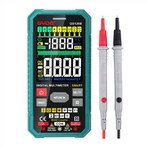
Can the clamp multimeter measure the breakpoint of the sheathed wire?
The so-called static refers to the measurement when both ends of the cable are removed and no power is applied. At this time, the clamp meter is used as an ordinary multimeter. The measurement method is: take one of the broken wires of the three-core cable as an example. The clamp meter is set to the diode position or the ohm position, and the ohm position must be set to zero. The method of bending the cable back and forth by hand is from one end of the cable to the other end. Search, and monitor the multimeter pointer or the value of the swing at the same time. When it is bent to a certain place, the value of the multimeter changes, indicating that the breakpoint is near the bend. Use a paper knife to cut the cable skin and try it with your hands. Pull it to see, usually the place where the disconnection is pulled will be pulled out. This is a method to find if there is a break in the cable or the distance between the two ends of the breakpoint is very close.
If there is more than one breakpoint or the breakpoint is far away, it is necessary to use a section to cut the cable skin and gradually reduce the scope of the fault until the breakpoint is found.
The so-called dynamic is when the power is turned on, because one line is broken, there is no current without a loop, and the clamp meter is useless without a current clamp. If the cable is powered on, connected to the electrical appliance, and the wire is clamped with a clamp meter to measure, and the method of bending the wire is used on the surface, it is feasible on the surface, but it is actually very unsafe. If the power of the electrical appliance is large, If the wire is suddenly connected during bending, it is easy to cause ignition, and even the outer skin catches fire. If it collides with the other two wires, there is a great potential safety hazard. This detection method should be used with caution.
Precautions for multimeter measurement accuracy
Human reading error is one of the reasons that affect the measurement accuracy. It is unavoidable but can be minimized. Therefore, pay special attention to the following points during use:
(1) Keep your eyes perpendicular to the pointer when reading;
(2) Before measurement, place the multimeter horizontally and perform mechanical zero adjustment;
(3) When measuring resistance, zero adjustment must be performed every time a gear is changed. Replace the battery with a new one when the adjustment is less than zero;
(4) When measuring the resistance in the RC circuit, cut off the power supply in the circuit, discharge the electricity stored in the capacitor, and then measure. After excluding the human-made reading errors, we conduct some analysis on other errors;
(5) When measuring resistance or high voltage, do not pinch the metal part of the test lead with your hands, so as to avoid shunting of human body resistance, increasing measurement error or electric shock.
Digital multimeters are also known as digital multimeters (DMMs), and there are many types and models. Every electronic worker hopes to have an ideal digital multimeter. There are many principles for choosing a digital multimeter, and sometimes they even vary from person to person. However, for a handheld (pocket) digital multimeter, it should generally have the following characteristics: clear display, high accuracy, strong resolution, wide test range, complete test functions, strong anti-interference ability, relatively complete protection circuit, and beautiful appearance , generous, easy to operate, flexible, good reliability, low power consumption, easy to carry, moderate price and so on.